

The strategic discourse surrounding the Indo-Pacific has hit a critical inflection point following Washington’s decision to revert its “Indo-Pacific Command” back to its historic “Pacific Command” designation. While some view this as a pullback in U.S. commitment and others dismiss it as a bureaucratic rebrand, both views overlook a deeper shift: America is actively rewriting its national and strategic identity around a post-WWII, MAGA-centric narrative.
Rather than treating this as a setback, the original architects of the Indo-Pacific concept—India and Japan—should view it as a historic opportunity. With Washington redefining its priorities, New Delhi and Tokyo must decouple the Indo-Pacific from purely Western strategic vocabulary and anchor it back in its native Asian foundations.
Moving Beyond the Prism of Rivalry
The concept of the Indo-Pacific was initially popularized by Japanese Prime Minister Shinzo Abe’s vision of the “confluence of the two seas” and operationalized heavily by Indian Prime Minister Narendra Modi. Over time, however, the definition narrowed into a purely militaristic, anti-China alliance framework.
A sustainable future for the region requires broadening this lens. While modern strategic friction with Beijing is real and must be managed with clear-eyed realism, a stable regional order cannot be built exclusively on rivalry. The Indo-Pacific is not just a geopolitical theater; it is one of the world’s oldest interconnected civilizational spaces, bound by millennia of trade, Buddhism, and cultural exchange. India and Japan must champion a narrative of connection over exclusion, positioning Southeast Asia not as a battleground for great powers, but as the central civilizational bridge between two oceans.
A Multi-Pillar Framework for a Sovereign Indo-Pacific
To ensure the region is not left vulnerable to the shifting political tides of successive U.S. administrations, India and Japan must expand their bilateral and plurilateral cooperation across four distinct pillars:
Execution and Global Platforms
The current diplomatic calendar provides the perfect launchpad for this refreshed doctrine:
-
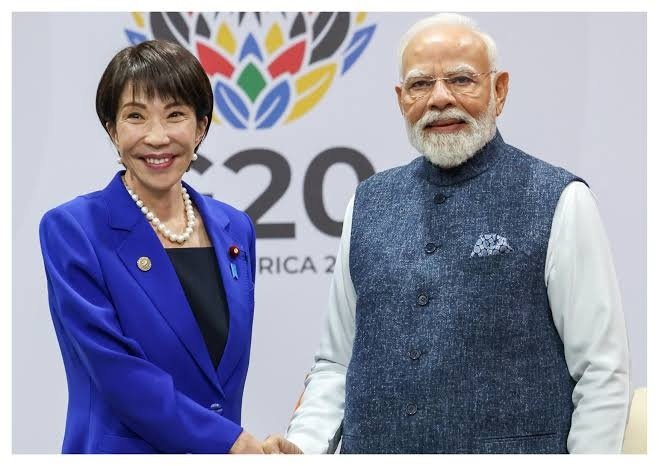
The Takaichi-Modi Bilateral: Japanese Prime Minister Sanae Takaichi’s current visit to New Delhi offers an immediate opportunity to move beyond standard defense and technology trade, introducing an intellectual and civilizational roadmap for the region.
-
The Florida G20 Summit: The upcoming G20 summit in Florida provides the global stage needed to present this complementary vision.
Strategic Takeaway: This evolution does not mean distancing from the United States. Deeper cooperation with Washington remains vital for regional balance. However, India and Japan must ensure that the Indo-Pacific remains strategically secure, economically dynamic, and civilizationally confident—written in Asia, by Asia.
