

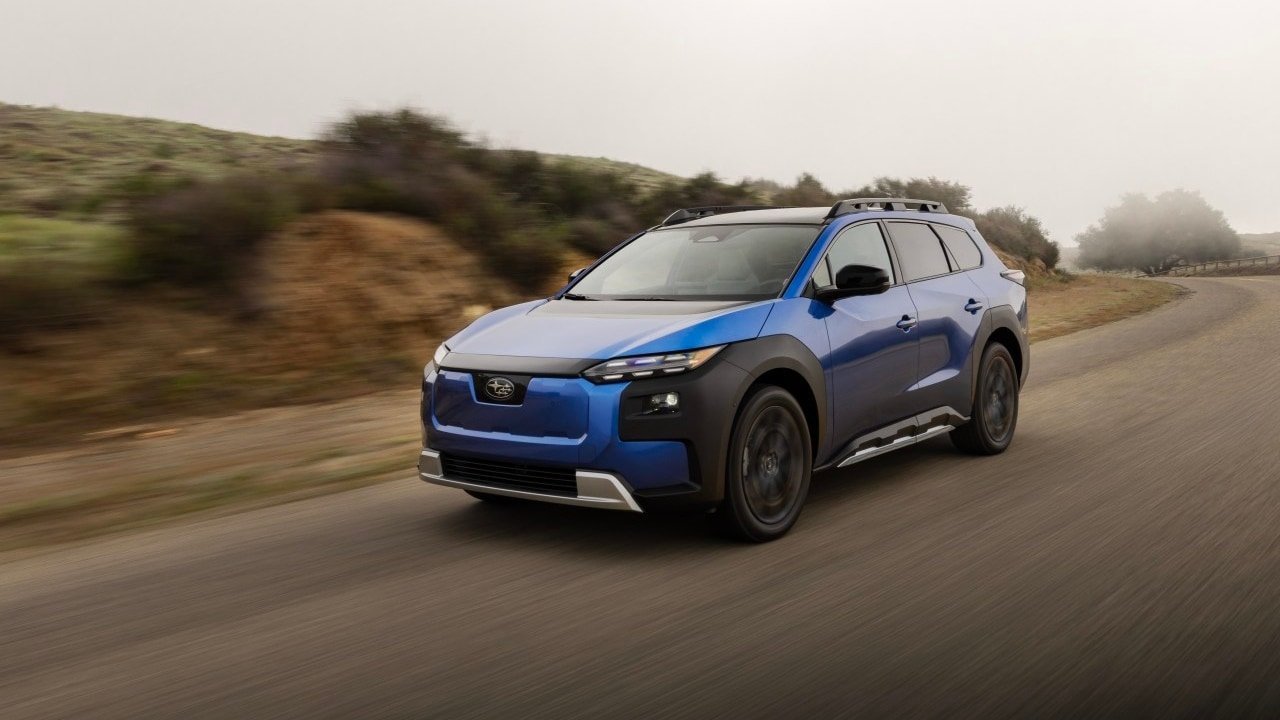
Electrification has long posed a philosophical challenge for Subaru. Brands and loyal fans historically wedded to the charismatic flat-four engine and mechanically linked all-wheel drive have often viewed an “electric Subaru” with skepticism. To bridge this gap without heavy in-house spending, Subaru turned to its partner Toyota—which owns a 20% stake in Subaru Corporation—to leverage its EV architecture.
The result is the 2026 Subaru Trailseeker (priced at $48,005 as tested), a midsize, two-row electric SUV that serves as a fraternal twin to Toyota’s bZ Woodland.
Design and Exterior Styling
While mechanical underpinnings and interior layouts are heavily shared, Subaru gave the Trailseeker a few distinguishing visual characteristics:
-
Unique Fascias: The front and rear fascias are entirely unique to Subaru, featuring a slightly longer roof and a more wagon-like hatch.
-
Rugged Cladding: Dark composite cladding lines the rocker panels, lower fascias, and wheel wells, signaling soft-road capabilities.
-
Smart Front Corners: The front corners are skinned with dense, injection-molded plastic over sheet steel—a practical design choice meant to lower soaring collision-repair costs by protecting vulnerable lighting and signal clusters.
-
Utility: Standard equipment includes roof rails with a 176-pound dynamic capacity and 8.5 inches of ground clearance.
Interior, Cabin Comfort, and Quirks
Opening the door reveals a cabin that, apart from the six-star emblem on the steering wheel hub, heavily mirrors its Toyota template:
-
Infotainment & Controls: Features a 14-inch center touchscreen running a recent Toyota infotainment system, dual inductive charging pads, and a push-to-turn gear selector in the center console.
-
Steering Wheel Revision: In a rare departure from the Toyota blueprint, Subaru opted for a 14-inch steering wheel flattened at both the top and bottom to improve ingress, egress, and instrument sightlines (though the upper rim can still partially obstruct the display).
-
The Missing Glove Box: Complex under-hood plumbing and coolant routing left zero space for a glove box or a front trunk (frunk), leaving concealed console storage as the primary alternative.
The top-shelf Touring edition adds premium touches like a panoramic sunroof, 20-inch alloy wheels, a heated steering wheel, heated front and rear seats, and built-in radiant leg warmers.
Powertrain, Performance, and Range
Mechanically, the Trailseeker comes in a single primary spec shared with the bZ:
-
Motor Setup: Dual-motor all-wheel drive featuring independent permanent-magnet motors on the front and rear axles, delivering a net 375 horsepower (marketed by Subaru as “Symmetrical AWD”).
-
Battery & Charging: Equipped with a 74.7-kWh lithium battery pack and a 400V charging system. It features a Tesla-compatible NACS charge port for supercharger access, though its max charging rate caps at 150 kW (translating to a 10%–80% recharge in roughly 28 minutes under ideal conditions).
-
EPA Range: Estimated at up to 274 miles (with maximum configurations hitting around 281 miles).
-
Speed: Dispelling any notion of sluggishness, it is remarkably quick, cracking a 0–60 mph sprint in just 3.9 seconds according to testing by Car and Driver.
Verdict
The 2026 Subaru Trailseeker delivers stout build quality, smooth highway ride comfort, impressive acceleration, and a $5,000 pricing and equipment advantage over its Toyota twin. However, its last-generation EV technology results in sub-par range and charging speeds relative to competitors like Tesla, slightly undercutting its potential for spontaneous, long-distance outdoor exploration.
