

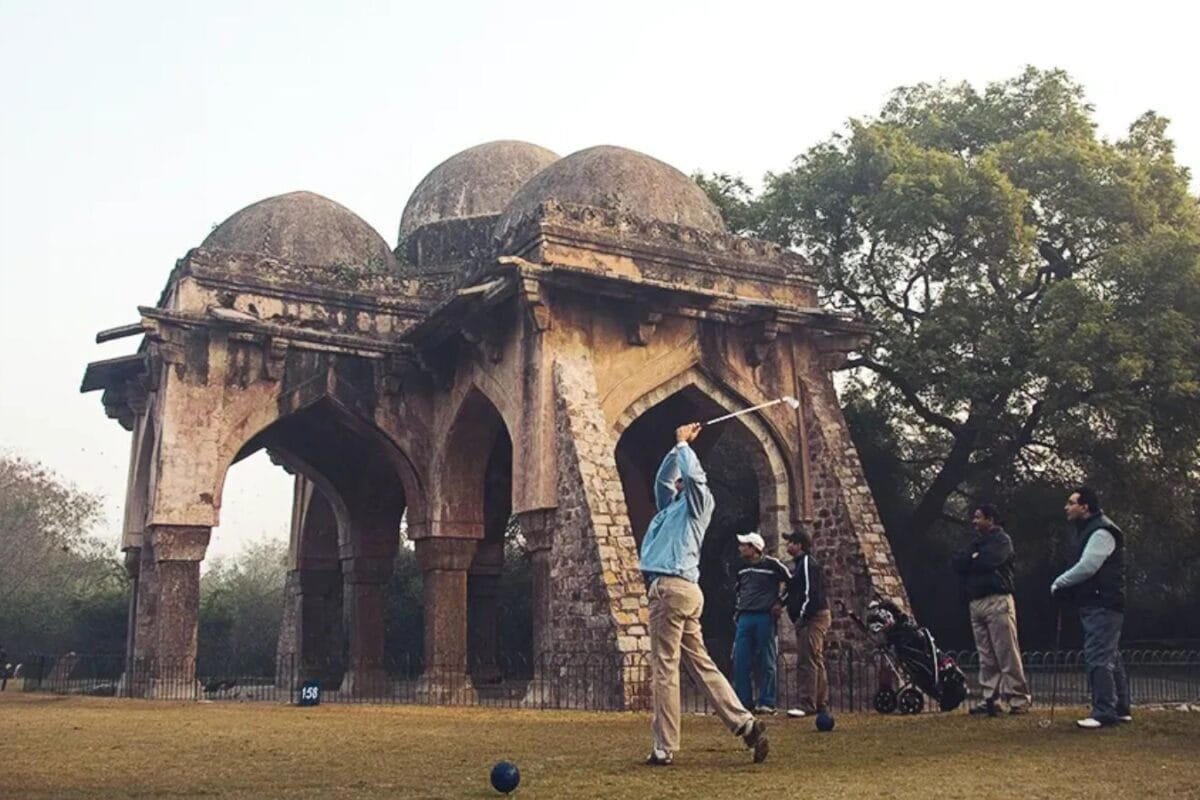
The intersection of Delhi’s elite social clubs and its immense repository of historical monuments has long been a source of friction. The news report details a critical escalation in this dynamic, highlighting a massive legal and logistical battle over heritage preservation.
The core of the issue centers on Lal Bangla I and II—two late-Mughal-era mausoleums (dating to 1779–1780) built of red and yellow sandstone. They stand directly adjacent to the entrance gate and compound wall of the ultra-exclusive, members-only Delhi Golf Club (DGC).
The Core Disputes Highlighted
The interview with Archaeological Survey of India (ASI) Director-General Yadubir Singh Rawat underscores three major fronts the agency is currently navigating:
1. The Delhi Golf Club Encroachment & Access Issue
-
The Public Barrier: Heritage activists have long pointed out that because Lal Bangla is physically boxed in by the club, the public has practically zero access unless they pass through the club’s private, strictly guarded gate.
-
The “Kitchenette” Violations: A Supreme Court-appointed spot survey team revealed an alarming proximity of commercial club activity to the protected monument. Portions of the club’s kitchen—complete with heavy boilers, fans, chimneys, and water tanks—were built less than 3 meters away from the centuries-old structures.
-
Legal Hammer: Under Section 20A of the Ancient Monuments and Archaeological Sites and Remains (AMASR) Act, a strict 100-meter prohibited buffer zone must be maintained around protected sites. The Supreme Court slammed the ASI for a “callous and casual approach” in letting this happen, issuing a personal notice to Rawat.
Current Legal Status: The Supreme Court initially ordered the immediate sealing of the club’s structures within the 100-meter zone and prohibited any activity within 20 meters of nine other unprotected ancient structures inside the club (including the Tughlaq-era Barah Khamba and the Tomb of Syed Abid). However, on extraordinary indulgence requested by the club’s counsel, the court has put the sealing order in abeyance until July 22, 2026.
2. Scientific vs. Physical Evidence in Religious Disputes
Rawat acknowledged the immense pressure on the ASI as it gets increasingly drawn into politically charged religious title disputes across India. He shed light on the methodology used to handle these sites:
-
The Tech Limitation: While advanced non-invasive tech like GPR (Ground Penetrating Radar), LiDAR, and photogrammetry are heavily utilized, Rawat admitted they cannot provide a flawless sub-surface blueprint.
-
The Conclusive Proof: He noted that actual physical excavation remains the most watertight evidence. For instance, at the Bhojshala complex in Dhar, Madhya Pradesh, the ASI’s conclusion relied heavily on tangible recoveries: 94 distinct sculptures and numerous ancient inscriptions in Sanskrit, Pali, and Brahmi.
3. Commercialization of Heritage
A growing trend among local governments is the push to lease out historical structures for corporate events, weddings, and private concerts to generate revenue (such as a 2025 Delhi Government proposal targeting 70–80 locally protected monuments).
Rawat clarified the central ASI’s stance against this:
-
Central Protections are Off-Limits: Centrally protected monuments under the ASI (like Humayun’s Tomb) are strictly barred from hosting weddings or private corporate functions.
-
The Sound and Light Alternative: Instead of private monetization, the ASI is expanding public Sound and Light shows to boost evening tourism, adding 12 new historical sites to the program, including Leh Palace and the Shore Temple in Tamil Nadu.
With 414 centrally protected monuments actively encroached upon across India, the outcome of the DGC standoff on July 22 will likely set a massive legal precedent for how strictly the 100-meter structural buffer zone is enforced against powerful private and public entities nationwide.
