

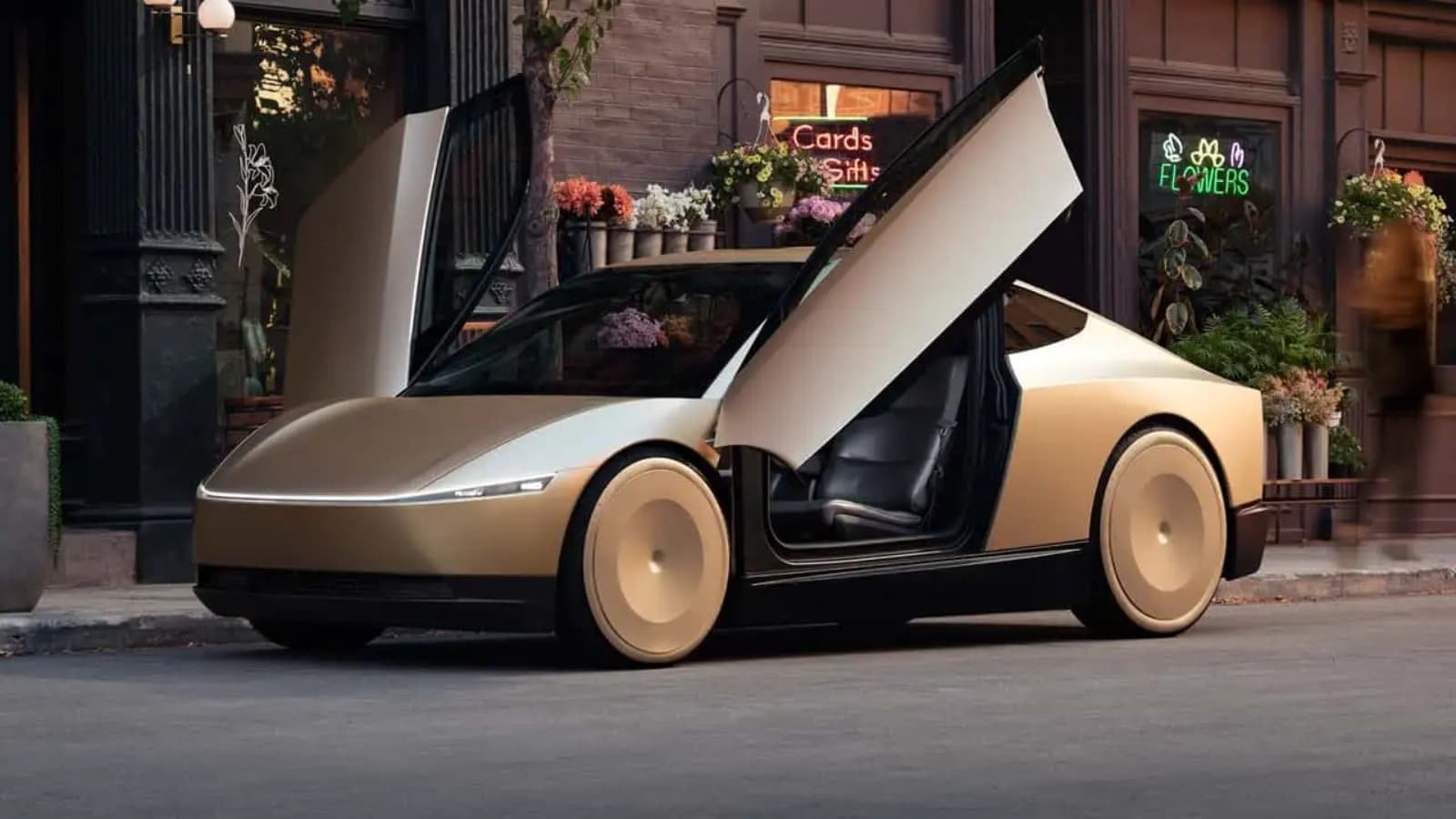
Tesla’s upcoming autonomous robotaxi, the Cybercab, has moved a massive step closer to reality. While the vehicle is not yet in mass production, public certification documents submitted to the United States Environmental Protection Agency (EPA) have revealed the comprehensive mechanical and engineering details of the highly anticipated two-seater.
The filings reveal a hyper-efficient design philosophy tailored to maximize range while keeping the footprint remarkably light.
Key Technical Specifications
The EPA application details a series of historical firsts for Tesla, including a brand-new drivetrain configuration.
| Attribute | Specification Details |
| Powertrain | Single AC 3-Phase Permanent Magnet Synchronous Motor |
| Drivetrain | Front-Wheel Drive (FWD) (A first for Tesla) |
| Peak Power Output | 163 kW (219 Horsepower) |
| Battery Capacity | 48.0 kWh Lithium-ion pack (326V) |
| Curb Weight | 1,412 kg (3,113 lbs) |
| Energy Efficiency | 165 Wh/mile (6 mi/kWh) |
Breaking Down the Numbers: Unprecedented Efficiency
The standout revelation from the EPA documents is the vehicle’s record-breaking efficiency. At 6 miles per kilowatt-hour (mi/kWh), the Cybercab effectively crowns itself as the most efficient production electric vehicle ever built, comfortably beating top tier competitors like the Lucid Air.
The Range Reality Check
Because the vehicle operates with an ultra-efficient 165 Wh/mi rating, its unadjusted laboratory testing numbers are staggering. However, real-world estimates tell a more practical story:
-
Unadjusted Laboratory Testing: The Cybercab completed laboratory test cycles with an unadjusted range of 673 km (418.2 miles).
-
Expected Real-World EPA Rating: Once standard EPA adjustment degradation factors (typically a reduction of around 30%) are applied to the raw bench data, the official real-world range is expected to sit between 450 km and 470 km (roughly 280 to 293 miles) on a single charge.
A Historic Mechanical Shift
Unlike Tesla’s existing consumer lineup—which prioritizes rear-wheel drive (RWD) or performance-oriented dual-motor all-wheel drive (AWD) architectures—the Cybercab adopts a strict front-wheel drive (FWD) layout. This mechanical shift highlights its design priority: low-speed city maneuverability, maximized regenerative braking efficiency, and utility over aggressive driving dynamics.
Lightweight Architecture
Weighing in at 1,412 kg (3,113 lbs), the Cybercab is roughly 750 pounds lighter than the standard-range Tesla Model 3. This featherweight build is achieved through its compact, purpose-built footprint. Designed natively as a Level 4 autonomous vehicle, it completely sheds heavy traditional components like steering wheels, pedal assemblies, and complex dashboard electronics.
What Remains Under Wraps?
Current Development Status: While the EPA filing gives us an exact look at the vehicle’s physical internals, Tesla has yet to disclose official pricing tiers, exact charging speeds, or automated cleaning mechanics. Mass volume production for the Cybercab is tentatively targeted to begin in 2027.
