

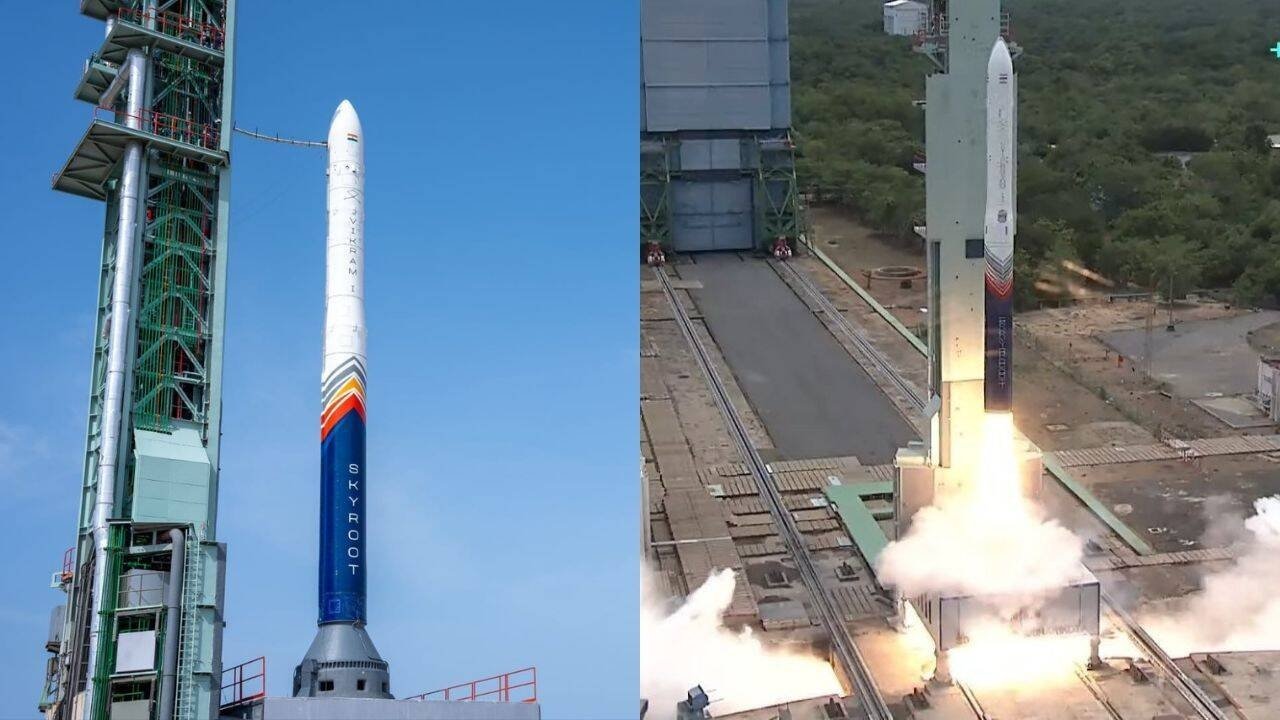
The successful maiden orbital launch of Skyroot Aerospace’s Vikram-1 rocket represents a historic milestone for India’s space sector. Reaching a Low Earth Orbit (LEO) at an altitude of approximately 450 kilometers, the Hyderabad-based startup has become the first private Indian entity to put a satellite into orbit—a feat praised by Prime Minister Narendra Modi in his Mann Ki Baat address as a testament to the potential of India’s youth.
However, behind Skyroot’s victory lies a deeper story of institutional hand-holding, technical guidance, and infrastructure support provided by the Indian Space Research Organisation (ISRO).
Vikram-1: Technical Overview
Standing 22 meters tall with an all-carbon-composite structure, Vikram-1 is engineered for cost-effective, rapid-deployment satellite missions.
| Metric / Component | Specification / Feature |
| Height & Structure | 22 meters; All-carbon-fiber composite airframe |
| Propulsion Architecture | 4-Stage configuration (3 solid fuel stages + 1 liquid upper stage) |
| Payload Capacity | Up to 350 kg to Low Earth Orbit (LEO) |
| Key Innovations | 3D-printed liquid engine components, low-shock payload separation |
| Deployed Payloads | In-house SCOPE satellite, Grahaa Space’s Solaras, and experimental payloads |
ISRO’s Mentorship & Infrastructure Support
While Skyroot assumed the financial and operational risk, ISRO provided the foundational ecosystem required to execute an orbital launch:
-
Propellant & Testing Facilities: First-stage solid motor propellant casting, along with static firing tests for the second and upper liquid stages, were performed at specialized ISRO facilities.
-
Launch & Range Infrastructure: ISRO made its Sriharikota launch pad available, managing range safety operations, flight trajectory tracking, and final launch clearance via a board headed by ISRO veteran Dr. B.N. Suresh.
-
Talent Transfer: Over 30 former ISRO scientists and engineers—including V. Gana Gandhi, now Senior Vice President at Skyroot—brought decades of launch vehicle development experience to the young 28-year-average-age engineering team.
Looking Ahead: The Commercial Horizon
The successful launch marks a major validation of the 2020 space sector reforms facilitated by IN-SPACe, enabling Indian private enterprises to access national space infrastructure.
As Skyroot prepares to transition from a successful technology demonstration to commercial flight cadences, it enters a competitive global small-satellite launch market. With plans to scale operations, Skyroot aims to offer regular, cost-effective launch services to both domestic and international commercial satellite operators.
