

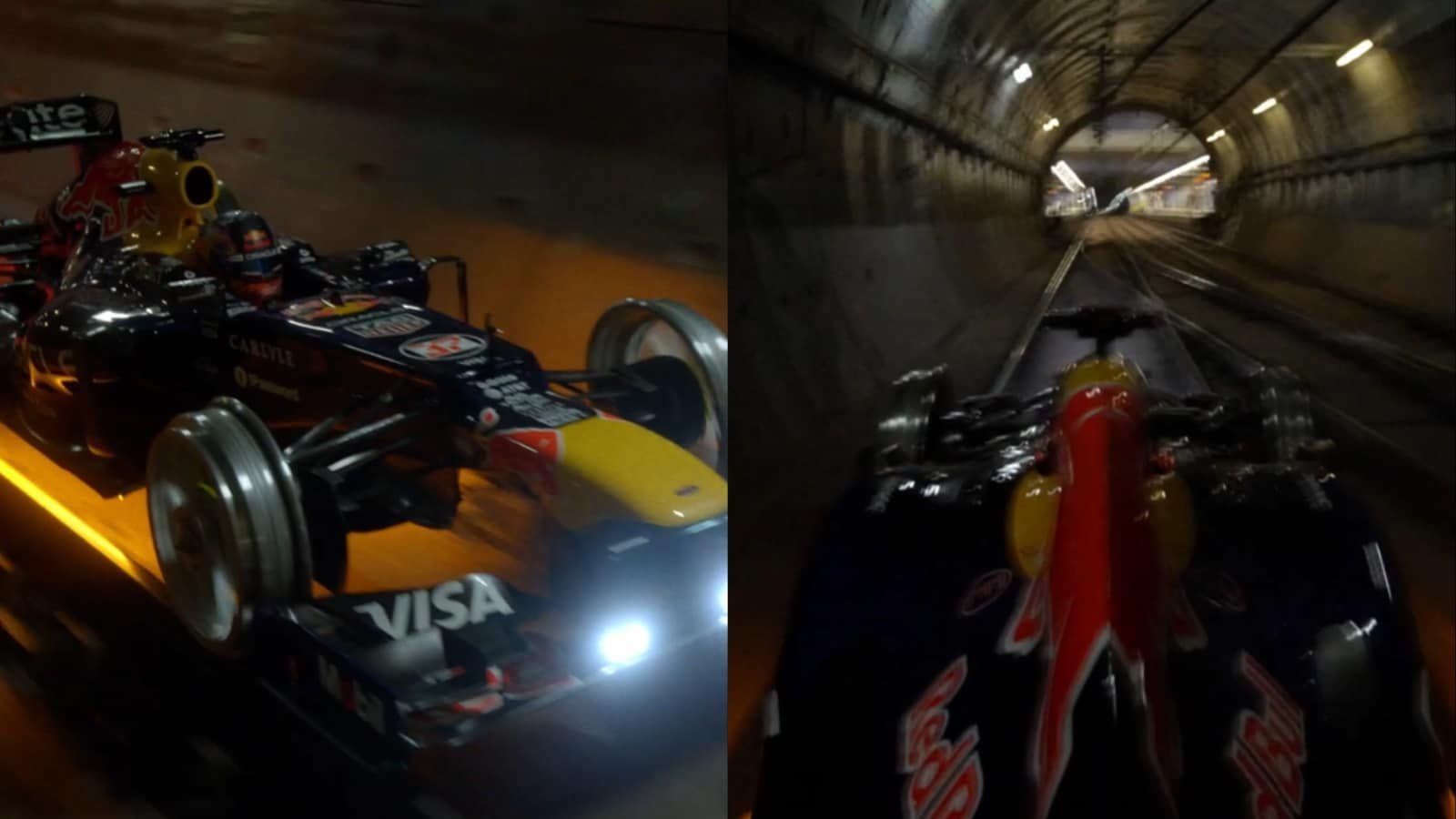
Red Bull Racing has captured global attention with one of its most eccentric and technically challenging promotional stunts to date, running Sebastian Vettel’s 2012 championship-winning RB8 Formula One car on the underground train tracks of the Madrid Metro. Executed ahead of the Spanish capital’s historic return to the F1 calendar, the viral campaign turned the common racing idiom—that a perfectly tuned car runs “as if on rails”—into a literal, high-octane reality.
The Engineering Challenge: Transforming an F1 Car Into a Train
The centerpiece of the stunt was the iconic RB8, the legendary machine that propelled Sebastian Vettel to his third consecutive Drivers’ World Championship and secured Red Bull’s third successive Constructors’ title during the 2012 season. Collaborating closely with the Canillejas workshop in Madrid, Red Bull’s specialized Heritage team faced the monumental task of re-engineering an aerodynamic open-wheel racer designed for smooth asphalt to operate safely on a subterranean railway network.
-
Custom Railway Wheels: Mechanics replaced the standard carbon-composite wheels with bespoke, heavy-duty steel wheels. Each wheel weighed 29.8 kg—roughly double the weight of a typical F1 wheel—meticulously designed to match the precise gauge of the Madrid Metro tracks without compromising the structural integrity of either the vehicle or the underground infrastructure.
-
Rapid Turnaround: The conversion was completed under tight time constraints, requiring rigorous testing within closed sections of the city’s underground network before filming could commence.
Behind the Wheel: Patrick Friesacher’s Underground Run
Former Minardi F1 driver and Red Bull Heritage pilot Patrick Friesacher was entrusted with driving the modified RB8 through the tunnels. Navigating a route that encompassed parts of the network near the Estadio Metropolitano station alongside the Sacedal and Chamartin depots, Friesacher brought the screaming V8 engine to life in an environment entirely unaccustomed to the symphony of motorsport engineering.
Reflecting on the surreal experience, Friesacher noted that adding “Metro driver” to his racing resume was an unbelievable highlight of his career with the Red Bull Heritage team, given the unique acoustic and spatial constraints of driving an F1 car deep underground.
Celebrating F1’s Return to Madrid
The spectacle served as a high-profile prelude to Formula One’s long-awaited return to Madrid for the first time in 45 years. The capital’s last Grand Prix took place in 1981 at the Jarama circuit, a legendary race won by Ferrari’s Gilles Villeneuve ahead of Jacques Laffite and John Watson, featuring iconic eras of motorsport gladiators like Nigel Mansell and Nelson Piquet. With the sport moving to the modern Madring street circuit layout designed to bring premier open-wheel racing back into the urban core, Red Bull’s underground run provided a brilliant promotional bridge between the sport’s rich historical legacy and its modern future.
