

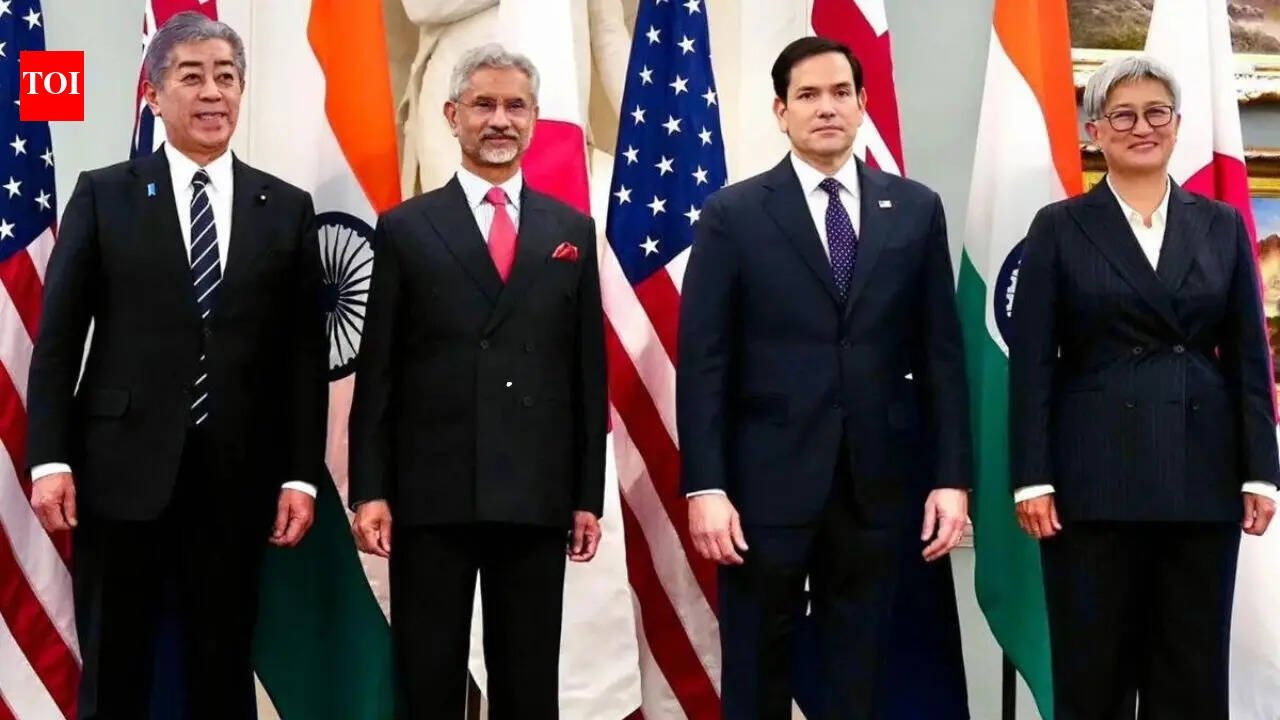
Foreign ministers from the United States, Japan, India, and Australia are gathering in New Delhi today for a critical meeting aimed at reviving the momentum of the Quadrilateral Security Dialogue (Quad). The high-stakes summit comes on the heels of recent diplomatic and economic friction between US President Donald Trump and Indian Prime Minister Narendra Modi.
While the coalition originally gained major prominence during Trump’s first term as a unified front against China’s growing footprint in the Asia-Pacific, recent bilateral disputes have raised questions about its future traction, with the grouping’s leaders having not met since 2024.
Overcoming Economic and Diplomatic Friction
The meeting in New Delhi serves as a crucial damage-control exercise following a series of strain points between Washington and New Delhi over the past year:
-
The Tariff Clash: Tensions flared last year when President Trump slapped a 50% tariff on Indian goods in retaliation for New Delhi’s continued purchase of Russian oil—tariffs that were only lowered after intense bilateral negotiations.
-
Geopolitical Disagreements: Relations were further tested after PM Modi rejected Trump’s claims of having brokered an India-Pakistan ceasefire.
-
The Diplomatic Push: US Secretary of State Marco Rubio has spent the last few days in India attempting to stabilize the relationship and prevent further “strategic drift” in the region.
A Complex Global Backdrop
The ministers are convening at a time of fast-moving global developments. Last week, President Trump held talks with Chinese President Xi Jinping to stabilize US-China ties, even as Beijing maintains its territorial pressures on Taiwan. Simultaneously, Washington and Iran are reportedly closing in on a deal to extend a ceasefire and reopen the strategic Strait of Hormuz—a vital energy transit corridor for Asian economies, particularly India.
Balancing Active Alliances with Non-Alignment
For India, hosting the Quad ministerial meeting highlights its delicate geopolitical balancing act. While External Affairs Minister S. Jaishankar emphasized that cooperation among the four “maritime and democratic powers” will continue to grow, New Delhi remains committed to its traditional non-aligned stance.
Following his friction with Trump last year, PM Modi engaged in friendly dialogues with both Xi Jinping and Russian President Vladimir Putin at a regional summit. India is also preparing to host the BRICS summit this September, which is expected to bring both Xi and Putin to New Delhi.
The Agenda Ahead
According to statements from the Indian and Japanese Foreign Ministries, the conversations will focus on:
-
Maritime security and Indo-Pacific coordination.
-
Securing critical mineral supply chains and technology.
-
Infrastructure development and disaster relief.
“One should not expect major announcements from the Quad meeting,” noted Pramit Pal Chaudhuri, South Asia practice head at Eurasia Group. Instead, the gathering is viewed as a vital foundational effort to keep the four-nation architecture intact during a turbulent phase of American foreign policy.
