

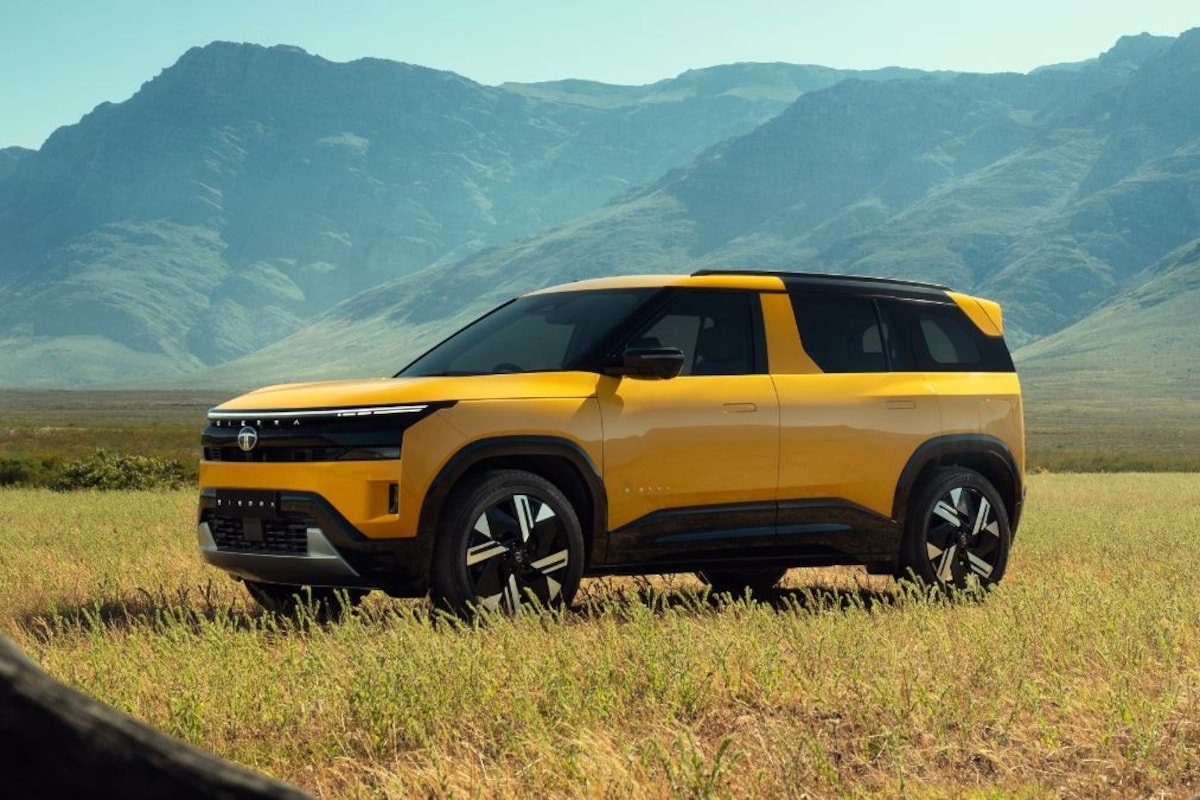
Tata Motors is striking a deep chord of automotive nostalgia by officially confirming June 30, 2026, as the global debut date for the production-ready Sierra.ev.
First showcased as an ambitious concept back at the 2020 Auto Expo, the modern rebirth of this legendary nameplate will bridge the gap between classic design heritage and clean, cutting-edge electric mobility.
1. Reliving the Legend: Exterior Design
The original 1990s Tata Sierra remains a cult classic, and Tata has taken careful steps to ensure the new electric avatar honors its roots:
-
The Silhouette: The production model retains the signature, unmistakable Alpine-style wrapping rear quarter glass area paired with an upright, boxy stance.
-
The EV Distinctions: To visually separate it from its upcoming internal combustion engine (ICE) counterpart, the Sierra.ev gets a completely closed-off, body-colored front fascia, full-width connected LED daytime running lights (DRLs), aerodynamically optimized flush door handles, and exclusive
.evbadging.
2. Advanced acti.ev+ Architecture
Underneath its retro-modern body, the Sierra.ev is built entirely on Tata’s advanced acti.ev+ architecture—the same high-voltage, software-driven platform that powers the Harrier EV.
| Technical Specification | Expected Details & Configurations |
| Battery Pack Options | 65 kWh and 75 kWh high-density packs |
| Claimed Range | In the region of 500 km to 550 km on a full charge |
| Drivetrain Layouts | Available in both Rear-Wheel Drive (RWD) and All-Wheel Drive (AWD) |
| AWD Availability | Expected to be limited strictly to the larger 75 kWh battery variants via a dual-motor setup |
| Charging Tech | Supports Vehicle-to-Load (V2L) and Vehicle-to-Vehicle (V2V) power sharing |
3. The Triple-Screen Premium Cabin
The interior layout repositions the Sierra nameplate squarely into the premium, tech-luxury bracket.
Higher-spec variants are set to debut an ultra-modern triple-screen layout across the dashboard: a 10.25-inch digital driver’s display, a massive 12.3-inch central infotainment hub running advanced connected car tech, and a secondary 12.3-inch screen dedicated entirely to the front passenger.
Comfort features like a massive panoramic sunroof, multi-zone climate control, ventilated and electrically adjustable front seats, and a full Level 2+ ADAS suite ensure it matches modern flagship standards.
4. Market Position & Competitors
The Sierra.ev will slot neatly into Tata’s product pipeline right above the Curvv.ev and just below the flagship Harrier EV.
To lower the barrier of entry, reports suggest Tata might introduce its Battery-as-a-Service (BaaS) model here. This would decouple the initial cost of the battery from the vehicle shell, keeping the entry-level ex-showroom pricing extremely competitive.
-
Expected Price Range: Rs 18 Lakh to Rs 25 Lakh (Ex-Showroom)
-
Key Rivals: Hyundai Creta EV, Maruti Suzuki e Vitara, Mahindra BE 6, and the MG ZS EV.
By merging heavy automotive nostalgia with dual-motor AWD capability and a premium lifestyle cabin, the Sierra.ev is poised to become one of the most significant Indian automotive moments of 2026.
