

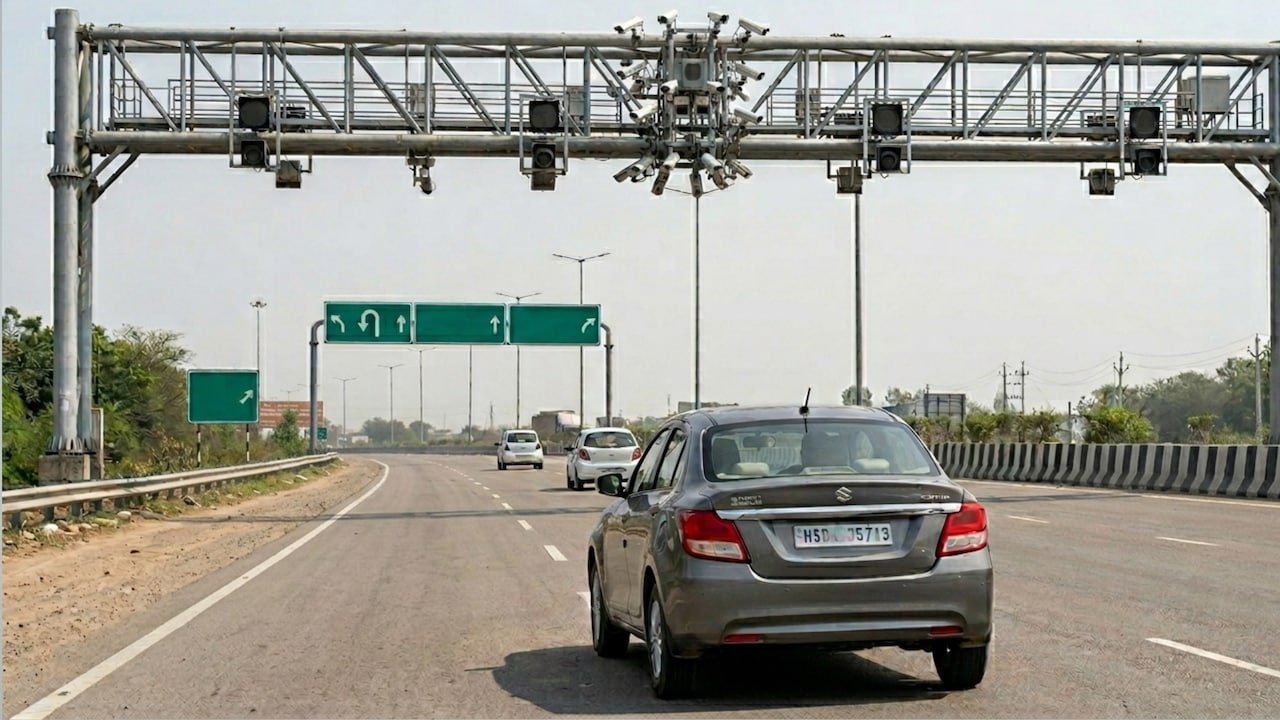
Commuters and commercial drivers entering Delhi will soon experience hassle-free border crossings. The Municipal Corporation of Delhi (MCD) has initiated a massive infrastructure upgrade to introduce a Multi-Lane Free Flow (MLFF) toll collection system.
Acting on directions from the Supreme Court, this barrierless project will be deployed across all 154 entry points into the national capital. The primary goal is to completely eliminate long queues, cut idling fuel consumption, and substantially decrease toxic vehicular emissions at Delhi’s heavily congested borders.
What is the Multi-Lane Free Flow (MLFF) System?
The MLFF system transforms standard, slow-moving border checkpoints into free-flowing stretches of road. Unlike traditional highway FASTag lanes where drivers must slow down or pause for a boom barrier to lift, this system requires zero stoppage.
Toll charges and Environmental Compensation Charges (ECC) are deducted automatically while vehicles maintain their normal driving speed. To ensure high accuracy and zero system downtime, the MCD will construct at least two overhead gantries (one primary and one backup) in each direction, positioned roughly 200 meters ahead of the current toll zones.
The Core Technology Package
The automated, technology-driven model replaces manual intervention with a robust matrix of high-tech sensors embedded with Artificial Intelligence (AI):
-
RFID Antennas & Readers: Instantly detect and process active Radio Frequency Identification (RFID) tags attached to incoming vehicles.
-
ANPR High-Definition Cameras: Automatic Number Plate Recognition cameras capture license plates in real time to validate the vehicle against central vehicle databases.
-
LIDAR & RADAR Sensors: Advanced Light Detection and Ranging (LIDAR) paired with radio-wave tracking (RADAR) dynamically maps vehicle dimensions to identify classification types (e.g., commercial trucks vs. passenger cars).
-
Infrared & Surveillance Matrix: Continuous illumination and monitoring loops ensure clear license plate captures even during heavy fog or pitch-black nighttime conditions.
Target Zones & Enforcement
The project focuses on fixing severe, chronic bottlenecks at key commercial entry arteries, including:
-
Ghazipur Border
-
Rajokri Border
-
Badarpur Border
-
Sirhaul (Delhi-Gurugram Expressway) Border
| Current System Challenges | New MLFF System Impact |
| Frequent stop-and-go queuing | Uninterrupted highway speed movement |
| Severe localized pollution from idling engines | Lower carbon footprint at entry zones |
| Manual validation errors & toll evasion loopholes | AI-powered automatic non-compliance flaggers |
| Slow bottlenecks from low FASTag wallet balances | Instant camera-logged registration tracking |
Strict Non-Compliance Penalties: Evading the system will become incredibly difficult. Vehicles entering without a functional or adequately funded RFID tag will be automatically logged by the ANPR camera matrix. Owners will be heavily penalized under the strict statutory provisions of the Delhi Municipal Corporation Act (1957) and the DMC Toll Tax Bye-Laws (2007).
The MCD has officially floated tenders to finalize an experienced tech firm to design, build, and maintain this advanced network for a fixed five-year period, targeting an estimated annual revenue collection of around ₹910 crore.
