

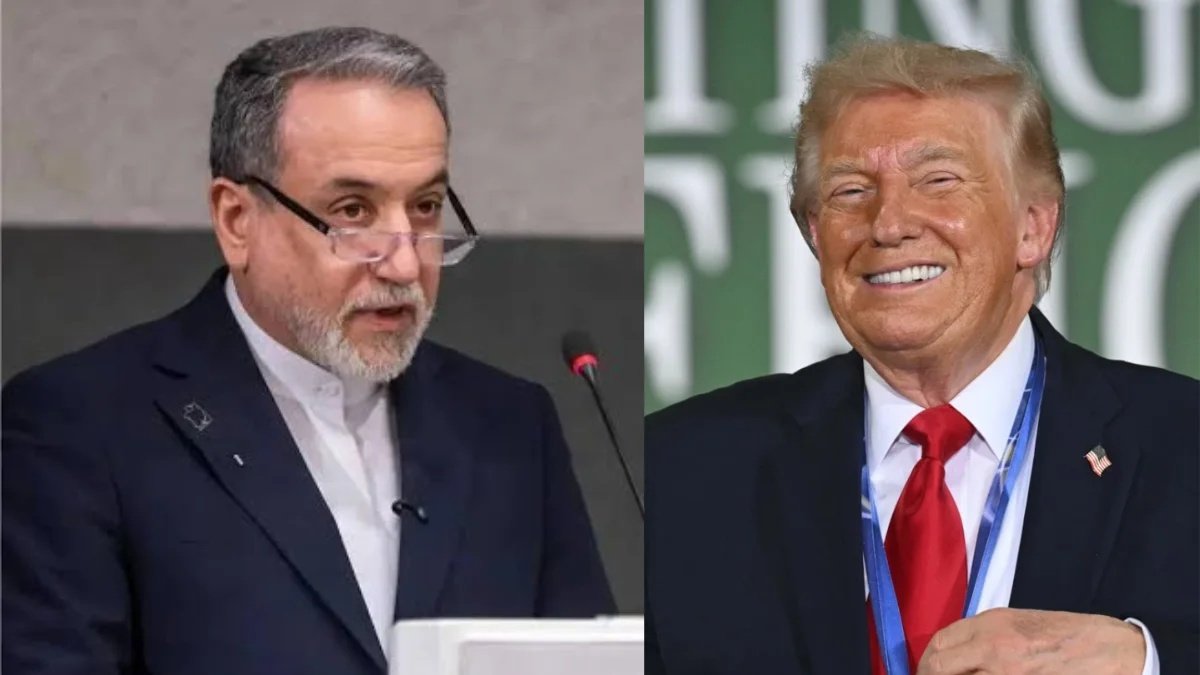
Amid an intense wave of continuous U.S. airstrikes hitting Iranian cities, Iran’s Foreign Minister Abbas Araghchi has revealed the harrowing psychological environment surrounding backchannel peace negotiations with Donald Trump’s special envoy, Steve Witkoff.
In a raw interview with the state-linked Mehr News Agency, Araghchi detailed how the shadow of American and Israeli military strikes looms directly over Iranian diplomats, making every communication feel potentially fatal.
Negotiating Under the Shadow of Death
Araghchi, a veteran negotiator who has maintained an intermittent, multi-capital dialogue with Witkoff since last year, recalled a chilling confrontational moment during their discussions. He described asking the American envoy if he had ever had to handle diplomacy under a literal threat of annihilation:
“I asked Witkoff, have you ever been in a meeting where at any moment you think the whole meeting might be bombed? Have you ever been on the phone while you’re talking, you might, as they say, explode, be destroyed? Have you ever, for example, while checking in on your family over the phone, thought to yourself this might be the last time?”
According to Araghchi, the American delegation “just stared blankly”. The top diplomat stressed that Washington’s strategy of absolute pressure failed because it cannot intimidate negotiators who already expect death at any moment. He claimed the current war erupted precisely because the U.S. realized it could not force a “zero uranium enrichment” concession at the negotiating table. “You have to talk. You can’t threaten us, and you can’t bribe us,” he added.
‘Iran is Not Venezuela’
Araghchi explicitly dismissed Washington’s assertions that intense military escalation or decapitation strikes would force the Islamic Republic into quick submission.
He drew a sharp contrast to South America, pointing out the January U.S. military operation that captured Venezuelan President Nicolas Maduro and flew him to New York for trial. Araghchi asserted that Iran’s decentralized political layout—a “mosaic power model”—ensures that the removal of a single leader cannot collapse the state apparatus.
“This isn’t Venezuela where you take one person and everyone else gets scared and backs down,” Araghchi stated.
Direct Strikes and Shattered Ceasefires
The diplomatic disclosures coincide with a total collapse of the June ceasefire framework. On Monday, U.S. Central Command (CENTCOM) launched its ninth consecutive night of airstrikes aimed at degrading Iran’s naval capabilities. According to Iran’s semi-official Tasnim news agency, U.S. missiles targeted major Iranian hub cities early Monday morning, including Tabriz, Chabahar, Konarak, Bandar Mahshahr, and Bandar Imam Khomeini.
In swift retaliation, the Islamic Revolutionary Guard Corps (IRGC) announced surprise drone and missile counter-strikes striking the U.S. special operations headquarters at the Al-Tanf complex in Syria, alongside heavy drone assaults on America’s Al-Adiri camp and Ali Al Salem Air Base in Kuwait.
