

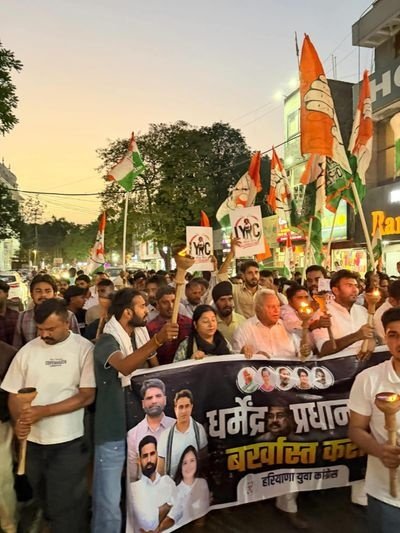
The Indian National Congress has announced plans to launch a massive, nationwide agitation starting from the end of June. The planned protests are designed to systematically corner the Narendra Modi-led Central government on domestic pressure points, specifically focusing on systemic unemployment, escalating inflation, and the ongoing national examination and paper leak crisis.
The movement, intended to span two to three months, marks a tactical push by the opposition to shift the national narrative. Notably, the announcement comes exactly a day after the BJP celebrated Prime Minister Narendra Modi’s milestone as India’s longest continuously serving elected head of government.
The Opposition’s Agenda: Key Friction Points
Following a high-level organizational meeting chaired by Congress President Mallikarjun Kharge and Leader of the Opposition (LoP) Rahul Gandhi alongside state unit chiefs, AICC General Secretary K.C. Venugopal outlined the primary pillars of the upcoming agitation:
-
The Student and Exam Crisis: Capitalizing on recent deep-seated public anger surrounding irregularities, paper leaks, and cancellations in major national examinations (including national competitive tests managed by the NTA), Congress plans to make youth and student distress a primary battleground.
-
Economic Strain & Inflation: The party highlighted the compounding financial stress on households due to the steady rise in daily essentials, explicitly pointing out escalating petrol, diesel, and LPG cylinder prices.
-
MSME and Job Distress: Venugopal asserted that the government’s policies have caused “economic destruction,” completely crippling the Micro, Small, and Medium Enterprises (MSME) sector—the traditional backbone of mass employment in India—and leaving millions of youth staring at an insecure future.
Accusations of “Seat Chori” (Seat Theft)
Beyond economic and youth issues, the Congress leadership took a sharp political swipe at the BJP’s methods of consolidation, bringing up local institutional flashpoints such as the rejection of senior Congress leader Meenakshi Natarajan’s Rajya Sabha poll nomination.
Venugopal strongly condemned the ruling party’s strategy of absorbing opposition lawmakers, stating:
“For making a majority, this is the way… they are taking all MPs from other parties and making them resign… this is actual after voting, vote chori ke baad, this is seat chori (seat theft). We will fight legally and politically.”
This friction comes at an incredibly volatile period in national parliamentary dynamics, especially with reports of parallel political upheavals—such as a massive internal split within West Bengal’s Trinamool Congress (TMC), where dozens of lawmakers are shifting toward the BJP-led NDA.
By taking to the streets for up to ninety days, the Congress is signaling that it intends to bypass standard parliamentary debates and directly mobilize public dissatisfaction over livelihood security, inflation, and institutional transparency.
