

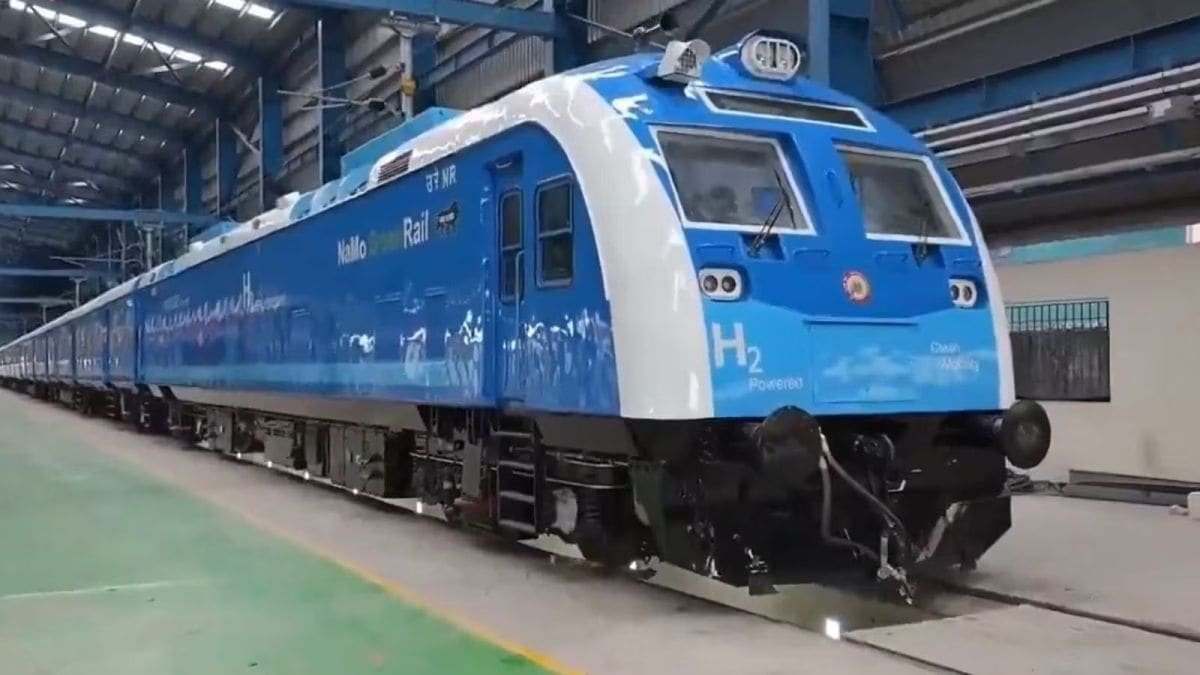
In a major leap toward green and sustainable transportation, the Ministry of Railways has officially approved the rollout of India’s first indigenously developed hydrogen fuel cell-based trainset. The zero-emission train will debut on a dedicated pilot corridor in Haryana, positioning India among an elite global club of nations—including Germany, China, Japan, and the United States—pioneering hydrogen rail technology.
Rather than relying on grid electricity or diesel, this train acts as its own rolling power plant, mixing onboard hydrogen with oxygen to generate electricity, leaving behind nothing but pure water vapor.
Key Technical & Operational Details
The pilot project introduces advanced Distributed Power Rolling Stock (DPRS) technology to the Broad Gauge platform, meaning the propulsion systems are spread intelligently across the trainset rather than pulling from a single heavy engine.
| Attribute | Technical Specifications & Logistics |
| Pilot Route | Jind – Sonipat section (Northern Railway zone, Haryana) |
| Train Structure | 10-car configuration consisting of 2 Driving Power Cars (DPCs) and 8 passenger coaches. |
| Power Output | 2,400 kW total (Two dual-propulsion units of 1,200 kW each). |
| Maximum Speed | Scheduled to operate up to 75 kmph. |
| Primary Depot | Scheduled maintenance will be handled at the Shakurbasti facility in Delhi. |
| Transit Protocol | When traveling between Jind and Shakurbasti for maintenance, the hydrogen systems will be shut down. The trainset will move in a “dead condition,” safely hauled by a traditional diesel locomotive. |
Strict Safety & Infrastructure Protocols
Because hydrogen handling requires meticulous precision, the Research Designs and Standards Organisation (RDSO) and the Commissioner of Railway Safety (CCRS) have mandated strict operational safeguards before commercial runs officially commence:
-
Dedicated Fueling Hub: An indigenous ground-level hydrogen production, storage, and dispensing facility has been built in Jind, fully licensed by the Petroleum and Explosives Safety Organisation (PESO).
-
Fail-Safe Detection: The fueling hub features a continuous network of automated flame sensors and hydrogen leak detectors. Maintenance crews are tasked with strict cleaning schedules to prevent regional dust from interfering with these safety sensors.
-
Human Supervised Launch: For the first three months of operation, a team of certified, specially trained technical experts will ride inside the train cabins to address any real-time mechanical glitches and closely monitor the fuel cell’s performance.
The Big Picture: This pilot launch directly serves India’s long-term national goal to achieve net-zero carbon emissions across the entirety of its rail network. It seamlessly accompanies other green transport alternatives rolling out across the country, such as the Delhi Metro Rail Corporation’s (DMRC) newly launched hydrogen-fueled shuttle buses operating around New Delhi’s Central Vista area.
