

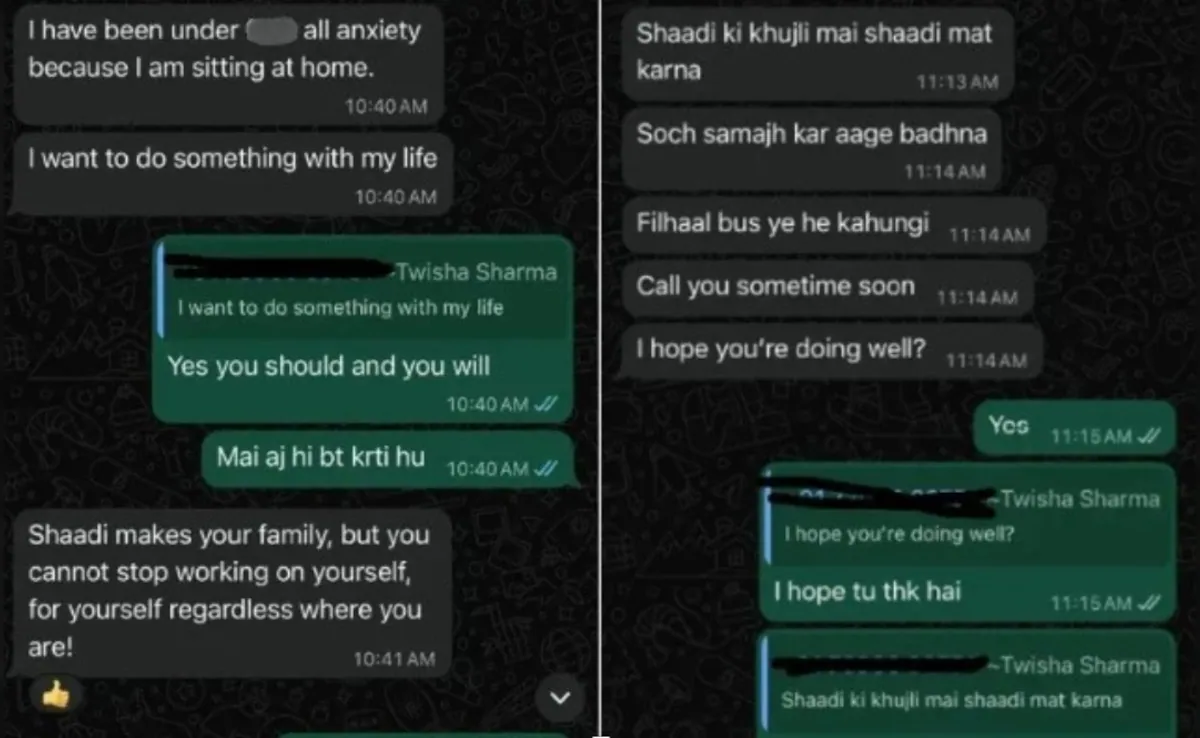
The final WhatsApp and Instagram messages sent by Twisha Sharma, a 33-year-old MBA graduate found dead in Bhopal, have surfaced, revealing intense emotional distress, severe anxiety, and a feeling of being “trapped” in the days leading up to her death.
Originally from Noida, Twisha was found hanging on May 12, 2026, at the Katara Hills residence of her husband, Samarth Singh, a local lawyer. The couple had met through a dating application in 2024 and married recently in December 2025. Prior to her marriage and relocation to Bhopal, Twisha had built a successful corporate career working for a firm in Delhi.
The Final Messages: “I Am Trapped, Bro”
The newly recovered chats show a stark contrast between Twisha trying to downplay her situation and expressing deep despair to her close friends.
The May 7 WhatsApp Conversation:
Twisha reached out to a close friend to vent about her isolation after moving to Bhopal, sharing her struggles with losing her financial independence:
“I have been under anxiety because I am sitting at home. I want to do something with my life. Shaadi makes your family, but you cannot stop working on yourself, for yourself regardless where you are,” she wrote.
In the same conversation, she explicitly warned her friend against rushing into marriage:
“Shaadi ki khujli me shaadi mat karna. Soch samaj kar aage badhna. Filhal bas yahi kahungi.” (Don’t rush into marriage just out of an urge to get married. Move ahead only after thinking it through carefully. For now, that’s all I’d say.)
When her friend expressed deep concern and asked her to call, Twisha tried to mask her pain, replying: “Main theek hoon. Mujhe bas ghar ki bahut yaad aati hai. Teri yaad aati hai.” (I’m fine. I just miss home a lot. I miss you.)
The Instagram Cry for Help:
In a separate, more alarming exchange over Instagram direct messages, Twisha’s tone turned urgent and fearful:
“I am trapped bro. Bas tu mat phasna. (I am trapped, bro. You just make sure you don’t get stuck.) Can’t talk much. I will call when the time is right.”
Family Protests at CM’s House, Demands AIIMS Delhi Autopsy
Twisha’s death has sparked massive outrage, culminating in her family staging a protest outside Madhya Pradesh Chief Minister Mohan Yadav’s official residence in Bhopal. The family refused to accept the initial local medical findings and demanded that a fresh, independent post-mortem examination be conducted at AIIMS Delhi.
The family stated that Twisha’s body had been kept inside the AIIMS Bhopal mortuary for five days while they ran “from pillar to post” trying to get the police to act.
“When we saw the body of my sister, the injuries that she was carrying, the continuous denial in admitting the crime, the repeated and continuous approach of the police to not get the FIR registered… we were made to run from pillar to post,” Twisha’s cousin, Ashish Sharma, told reporters.
While a preliminary short post-mortem report stated the immediate cause of death was hanging, the document noted multiple external injury marks across her body, severely contradicting suicide theories and prompting demands for a deeper forensic review.
SIT Formed Amis Dowry Harassment & Murder Allegations
| Accused Individuals | Professional Profile / Status | Family’s Primary Grievances |
| Samarth Singh | Lawyer (Husband) | Accused of systematic physical abuse, demanding illicit dowry, and ultimate murder. |
| Giribala Singh | Retired Judge (Mother-in-law) | Accused of using her high-profile legal influence to block local police procedures and shield her son. |
In response to growing public pressure and the suspicious injury marks, the state government has constituted a Special Investigation Team (SIT) to take over the case.
Twisha’s father, Navnidhi Sharma, has formally accused the mother-son duo of murder and dowry harassment. The family has voiced extreme concern that the local station police were compromised due to the family’s judicial status, pointing out that the accused party had allegedly secured swift anticipatory legal protections even before a comprehensive First Information Report (FIR) could be systematically recorded by the grieving family.
