

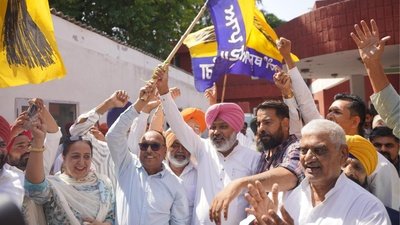
The ruling Aam Aadmi Party (AAP) has secured a landslide victory in the Punjab civic polls, securing its political dominance ahead of the crucial state assembly elections slated for early 2027.
In what was widely framed as a litmus test for Chief Minister Bhagwant Mann’s governance, AAP captured 862 wards out of the 1,765 counted across 102 urban local bodies. The principal opposition, Congress, finished a distant second, while independent candidates outpaced major established regional and national parties to take the third spot.
The Big Picture: Final Ward Tally
The elections saw 7,554 candidates fighting for control across 1,977 total wards, encompassing 8 major Municipal Corporations, 75 Municipal Councils, and 19 Nagar Panchayats.
| Political Party | Wards Won (Out of 1,765 Counted) | Position |
| Aam Aadmi Party (AAP) | 862 | 1st (Majority Share) |
| Indian National Congress (INC) | 348 | 2nd |
| Independents | 242 | 3rd |
| Shiromani Akali Dal (SAD) | 169 | 4th |
| Bharatiya Janata Party (BJP) | 138 | 5th |
| Bahujan Samaj Party (BSP) | 6 | 6th |
Key Corporation and Constituency Highlights
-
Dhuri (CM’s Turf): In Chief Minister Bhagwant Mann’s own assembly constituency of Dhuri, AAP staged a near-total clean sweep, winning 20 out of 21 seats.
-
Barnala: Out of 50 total wards, AAP registered an overwhelming victory in 36 seats. The BJP managed 7, Independents grabbed 5, and Congress was reduced to just 2.
-
Moga: AAP secured 29 seats, comfortably crossing the 26-councillor threshold required to cleanly elect its own Mayor.
-
Bathinda: AAP maintained its strong momentum, locking down 14 out of 21 seats.
-
Pathankot (Split Verdict): Bucking the statewide trend, Pathankot witnessed a tight, triangular contest. Congress emerged as the single largest party with 10 seats, closely followed by the BJP at 9, and AAP finishing third with 5.
Turnout Dynamics and Voter Demographics
The state Election Commission reported a solid overall voter turnout of 63.94% across Punjab’s urban landscapes. The intensity of voting varied significantly depending on the scale of the civic body, with smaller, semi-urban localities showing the highest enthusiasm.
-
Nagar Panchayats (Smallest Bodies): Recorded the highest public participation at 76.18% turnout (1.07 lakh votes cast out of 1.41 lakh electors).
-
Municipal Councils (Mid-Sized Towns): Registered a 65.06% turnout, forming the largest chunk of the voting population with 14.88 lakh votes cast.
-
Municipal Corporations (Major Cities): Saw the lowest comparative turnout at 59.91%, where 6.41 lakh citizens out of 10.71 lakh electors cast paper ballots.
Political Reactions and Conflict
The massive victory triggered sharp rhetorical exchanges from both sides of the aisle. Elated by the numbers, senior AAP leader Manish Sisodia publicly thanked the voters of Punjab for reposing faith in Arvind Kejriwal and CM Mann. He took direct aim at the central government, stating that “ED (Enforcement Directorate) politics” would not work in Punjab, claiming that over 1,100 BJP candidates had completely forfeited their security deposits.
Conversely, State Congress President Amarinder Singh Raja Warring defended his party’s performance, particularly praising their showing in major hubs like Patiala, Ludhiana, Amritsar, and Jalandhar. He lauded grassroots Congress workers for putting up a brave fight against what he alleged was an blatant abuse of power and systemic misuse of official government machinery by the ruling AAP.
Note on Polling Conditions: While counting proceeded under tight security starting at 8:00 AM on Friday, polling day itself was marred by sporadic violent clashes among rival party workers, alongside isolated allegations of booth capturing in multiple districts.
