

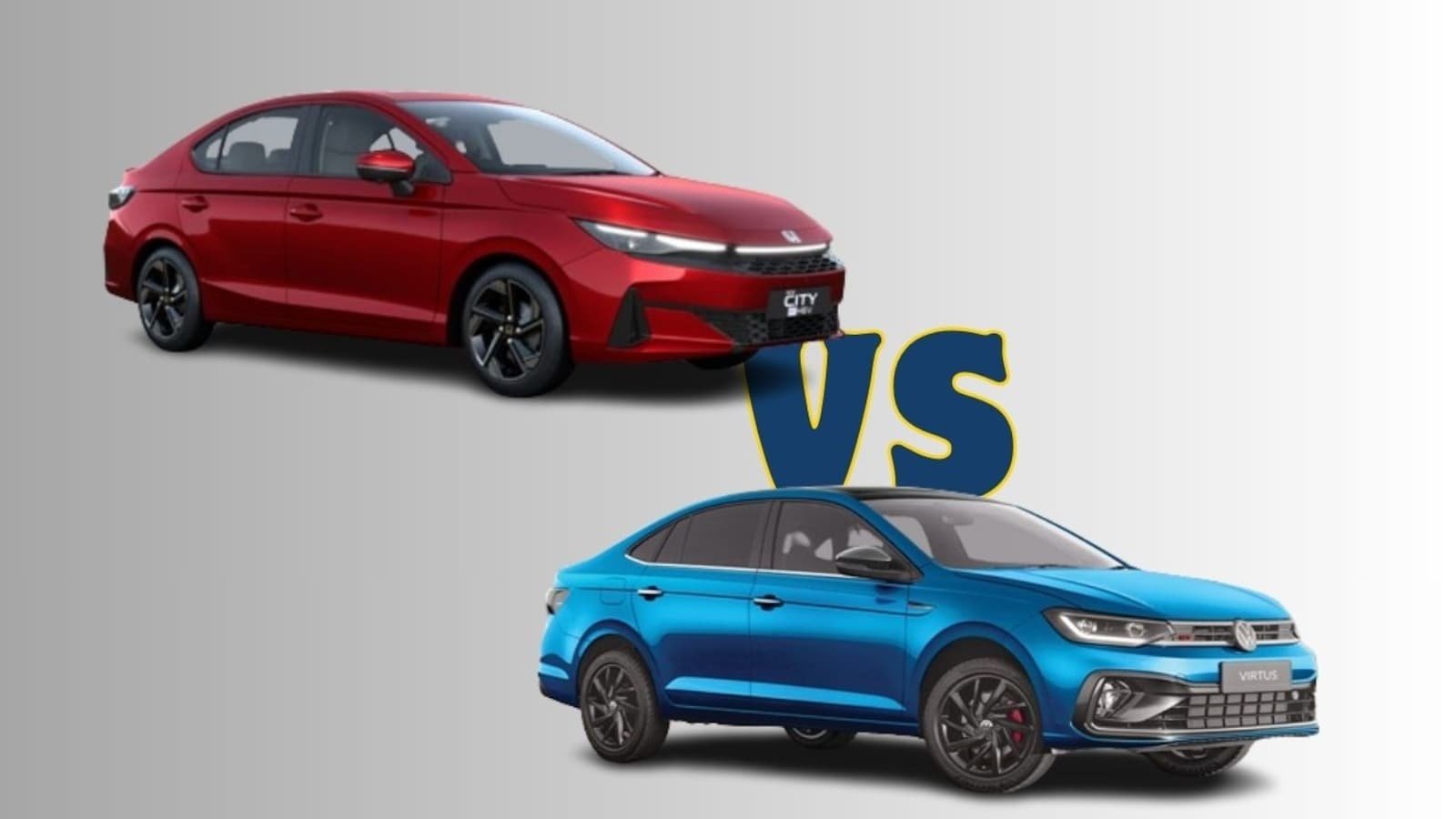
The mid-size sedan segment in India remains highly competitive, primarily highlighted by the recently launched 2026 Honda City Facelift and the popular Volkswagen Virtus. While Honda addresses executive elegance and state-of-the-art tech updates, Volkswagen continues to target driving enthusiasts with aggressive styling and turbo-petrol dynamics.
Here is a comprehensive breakdown of how these two prominent sedans stack up against each other.
1. Design and Dimensions
The Honda City Facelift retains its premium, sophisticated profile but introduces a sharper aesthetic. Updates include a wider, revised front grille with a stealthier appearance (the upper chrome bar has been removed), standard Bi-LED headlamps with a smoked effect, connected LED DRLs, a sporty rear bumper with a diffuser-like treatment, and a new Crystal Black Pearl paint option.
The Volkswagen Virtus stands out with a much more aggressive, European design language. Its bold front fascia, sleek LED lighting signature, and dark GT-Line elements give it a muscular and sporty road presence.
| Dimension | 2026 Honda City Facelift | Volkswagen Virtus | Winner |
| Length | 4,594 mm | 4,561 mm | Honda City |
| Width | 1,748 mm | 1,752 mm | Volkswagen Virtus |
| Height | 1,489 mm | 1,507 mm | Volkswagen Virtus |
| Wheelbase | 2,600 mm | 2,651 mm | Volkswagen Virtus (Better rear legroom) |
| Boot Space | 506 Liters | 521 Liters | Volkswagen Virtus |
2. Powertrain, Performance, and Efficiency
The performance philosophies of these two cars are completely different. Honda trusts linear power delivery and extreme fuel efficiency, whereas Volkswagen focuses entirely on forced induction (turbocharging) and driving thrill.
-
Honda City Facelift: Powered by the classic 1.5-litre i-VTEC naturally aspirated engine. It also uniquely offers a strong-hybrid (e:HEV) variant utilizing dual electric motors, generating a massive 253 Nm of torque and a stellar fuel economy rating of over 27 kmpl.
-
Volkswagen Virtus: Offered exclusively with Performance TSI turbo-petrol engines. The 1.0L TSI provides strong mid-range punch, while the enthusiast-focused 1.5L TSI puts down a class-leading 150 hp, making it considerably faster off the line than the standard City.
| Engine Type | Honda City Facelift | Volkswagen Virtus |
| Base Engine |
1.5L Naturally Aspirated Petrol • Power: 121 hp • Torque: 145 Nm |
1.0L Turbo-Petrol (TSI) • Power: 115 hp • Torque: 178 Nm |
| Performance/Hybrid Option |
1.5L Petrol Strong-Hybrid (e:HEV) • Power: 126 PS (Combined) • Torque: 253 Nm (Combined) |
1.5L Turbo-Petrol (TSI) • Power: 150 hp • Torque: 250 Nm |
| Transmission Options | 6-speed Manual / 7-step CVT / e-CVT (Hybrid) | 6-speed Manual / 6-speed Torque Converter / 7-speed DSG (Dual-Clutch) |
| Claimed Fuel Efficiency | 17.77 kmpl (MT) | 27.26 kmpl (Hybrid) | ~18.12 kmpl to 19.40 kmpl (TSI range) |
3. Cabin Comfort and Features
The 2026 facelift has notably elevated the Honda City’s tech package, closing the gaps with its European rival.
-
Where the Honda City Wins: It introduces highly requested ventilated front seats, an upgraded, larger 10.1-inch touchscreen system with wireless smartphone integration, and a 360-degree surround-view camera system.
-
Where the Volkswagen Virtus Wins: The Virtus features a highly sophisticated fully digital driver’s display, an ergonomic cockpit layout, and electrically powered front seats. However, it noticeably lacks a 360-degree camera system.
4. Safety and Driver Assistance (ADAS)
Safety is a top priority for both sedans, but they approach it with different technologies:
-
Honda City Facelift: Sweeps the safety category by making 6 airbags standard across all variants. Crucially, it brings a comprehensive Level-2 ADAS suite (Honda Sensing) to the segment, offering Adaptive Cruise Control, Lane Keep Assist, Road Departure Mitigation, and Collision Mitigation Braking.
-
Volkswagen Virtus: Built on the heavily fortified MQB-A0-IN platform boasting a 5-star Global NCAP safety rating. It features robust structural integrity, electronic stability control, and multi-collision brakes, but it completely misses out on ADAS functionality.
5. Price and Verdict
-
Honda City Facelift: ₹12.00 Lakh – ₹21.00 Lakh (Ex-showroom)
-
Volkswagen Virtus: ₹10.50 Lakh – ₹19.00 Lakh (Ex-showroom)
Final Recommendation
-
Buy the Honda City Facelift if: You want a seamless, stress-free ownership experience, a highly spacious executive cabin, advanced Level-2 ADAS safety tech, or if you want the strong-hybrid variant to slash your monthly fuel bills.
-
Buy the Volkswagen Virtus if: You love driving. The Virtus’ rigid chassis setup, aggressive GT styling, rapid-shifting DSG automatic transmission, and explosive 1.5L TSI engine make it the definitive choice for driving enthusiasts.
