

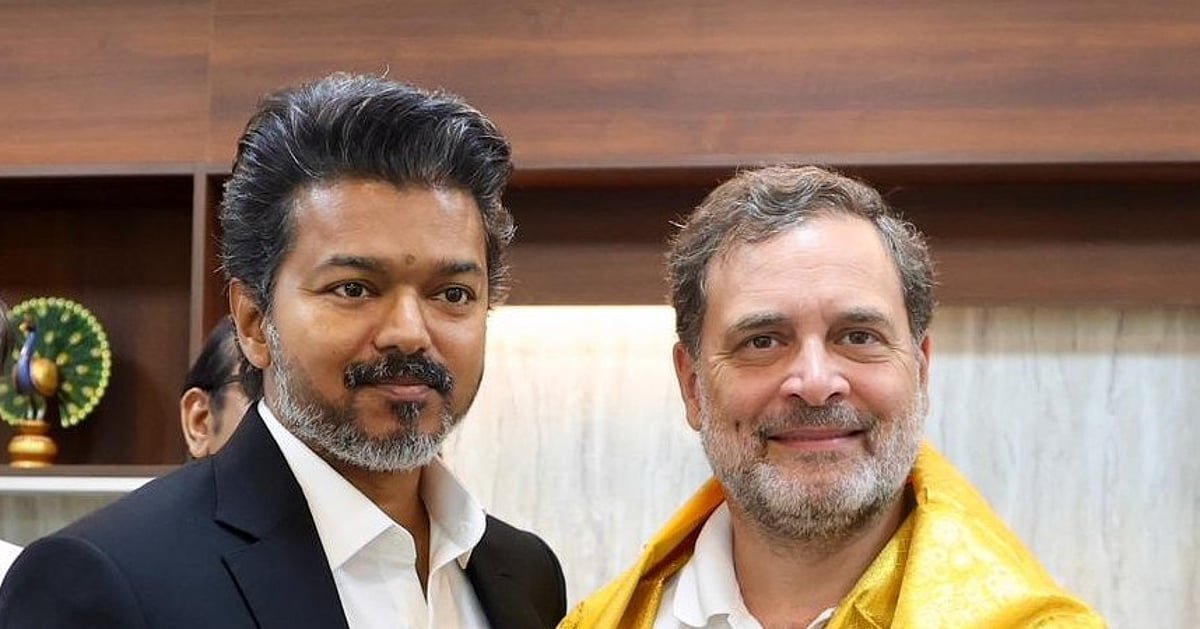
In a political realignment that has shattered over five decades of Dravidian duopoly, the Congress party has officially broken its 59-year absence from the Tamil Nadu cabinet. Congress MLAs Adv. Rajesh Kumar (Killiyoor) and Thiru P. Vishwanathan (Melur) were sworn in on Thursday morning as part of the 23-member cabinet under newly minted Chief Minister Joseph Vijay.
The stunning return to power marks a masterclass in post-poll leverage. Despite winning just five seats in the April 2026 assembly elections, the Congress successfully converted its minuscule numbers into maximum political capital, exploiting a fractured mandate to emerge as the ultimate kingmaker for actor-turned-politician Vijay’s Tamilaga Vettri Kazhagam (TVK).
The Math of a Mandate
The 2026 election delivered a historic shockwave, breaking the 62-year-old alternative rule of the DMK and AIADMK. However, while the TVK emerged as the single largest party, it fell agonizingly short of the magic number needed to govern solo.
Because Chief Minister Vijay contested and won two seats—Perambur and Trichy (East)—his impending resignation from one seat effectively set the active operational majority threshold at 118. The Congress’s five seats acted as the structural bridge, closing exactly half the gap and triggering a domino effect that emboldened other former DMK allies (including the Left parties and the VCK) to follow suit and solidify the TVK coalition.
The Anatomy of the Switch: From Defeat to Leverage
| Political Phase | Pre-Poll Reality (DMK Alliance) | Post-Poll Pivot (TVK Coalition) |
| Seat Share & Status | Contested 28 seats; won a meager 5 seats (down 13 from its previous tally). | Evaluated as “gold” by a vulnerable TVK desperate to cross the 118 majority mark. |
| Power-Sharing Terms | DMK boss MK Stalin flatly refused to promise cabinet berths to any junior allies. | CM Vijay honored his foundational campaign promise of giving a legitimate share in governance. |
| Ideological Caveat | Tied to a crumbling Secular Progressive Alliance (SPA). | Switched to TVK on a single condition: No communal forces (targeting the AIADMK-BJP front). |
A Seismic Shift in Tamil Nadu’s Power Play
For generations, the Dravidian majors maintained absolute control over the state’s administration, actively refusing to offer cabinet berths to national or junior allies under the rationale that power-sharing would dilute administrative efficiency.
By executing a swift, pragmatic exit from the defeated DMK camp, Congress leadership capitalised on the immediate on-ground reality. While the move drew fierce allegations of “backstabbing” from the DMK, it secured a historic milestone for the grand old party. The last time a Congress minister sat in a Tamil Nadu cabinet meeting was in 1967, under Chief Minister M. Bhaktavatsalam, right before C.N. Annadurai’s historic DMK wave permanently pushed national parties to the fringes of the state.
The Larger Lesson: The Tamil Nadu breakthrough serves as a blueprint for the Congress ahead of next year’s crucial state elections, particularly in states like Uttar Pradesh where the party has been marginalized since 1989. It proves that in an era of highly fractured mandates, even a handful of seats can dictate the formation of a government if a party moves with tactical speed.
