

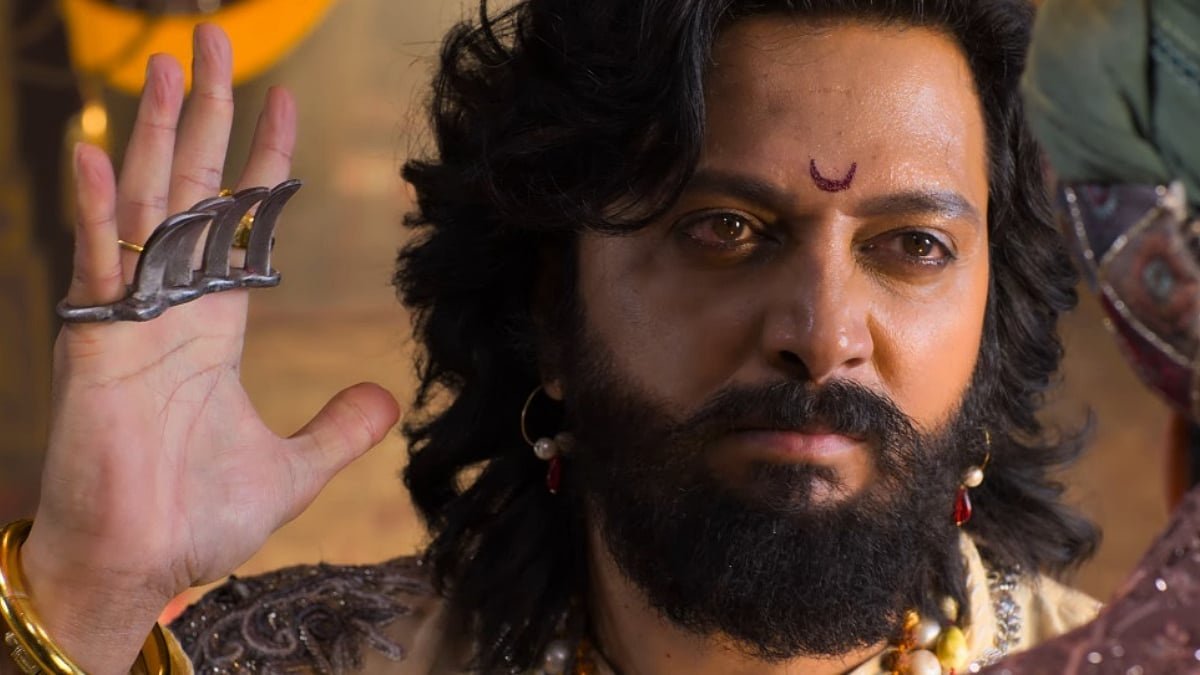
The upcoming release of Raja Shivaji, a magnum opus directed by and starring Riteish Deshmukh, has reignited a centuries-old debate: how exactly did Chhatrapati Shivaji Maharaj kill the formidable Adil Shahi general, Afzal Khan?
While the film’s trailer has drawn praise for its scale, it has also sparked historical scrutiny over its depiction of the iconic Wagh Nakh (tiger claw).
The Cinematic Controversy
The bone of contention lies in a specific moment in the trailer where Riteish Deshmukh’s Shivaji Maharaj openly displays the tiger claw to Sanjay Dutt’s Afzal Khan and delivers a heroic dialogue before the attack.
-
Public Outcry: Social media users have accused the film of “manipulating history,” arguing that showing the weapon beforehand eliminates the strategic element of surprise that was central to the Maratha king’s victory.
-
Expert Take: Historians, including Professor Anirudh Deshpande and Dr. Rahul Magar, suggest that in a real-world scenario, Afzal Khan would have likely ended the meeting or refused the embrace had he seen a weapon.
Fact vs. Fiction: The Expert Verdict
Experts remain divided on the mechanics of the 1659 encounter, highlighting the thin line between folklore and recorded history.
| Historical Point | Expert Consensus / Debate |
| Was a weapon used? | Fact. It is undisputed that Shivaji Maharaj killed Afzal Khan during their “unarmed” meeting at Pratapgad. |
| Was it the Wagh Nakh? | Debatable. While sources like the Sabhasad Bakhar mention it, some historians believe a Bichwa (dagger) or a Katiyar was more likely, as a tiger claw is difficult to keep fully concealed in a closed fist. |
| The Element of Surprise | Critical. Historians agree that Shivaji, being shorter than the heavily built Khan, relied on the “bear hug” to get close and use concealed weapons to strike the abdomen. |
| The “Rings” Theory | Venetian traveler Niccolao Manucci suggested the weapon was designed like an ornamental ring with a precious stone, hiding the claws inside the palm. |
The “Original” Wagh Nakh
The artifact currently on loan from London’s Victoria and Albert Museum (displayed in Satara) is often cited as the original weapon. However, Dr. Rahul Magar notes that even the museum has never officially claimed it is the actual 17th-century weapon used in the killing, only that it is an authentic period piece.
Cinema vs. Documentary
Despite the historical inaccuracies, experts urge the public to view Raja Shivaji as a work of art rather than a textbook.
“We should give that much liberty to the filmmakers. It is a movie, not a documentary.” — Dr. Rahul Magar, Savitribai Phule Pune University.
Raja Shivaji is set to hit theaters on May 1, 2026, promising a high-octane retelling of the Maratha legend that prioritizes cinematic heroism over rigid historical reconstruction.
