

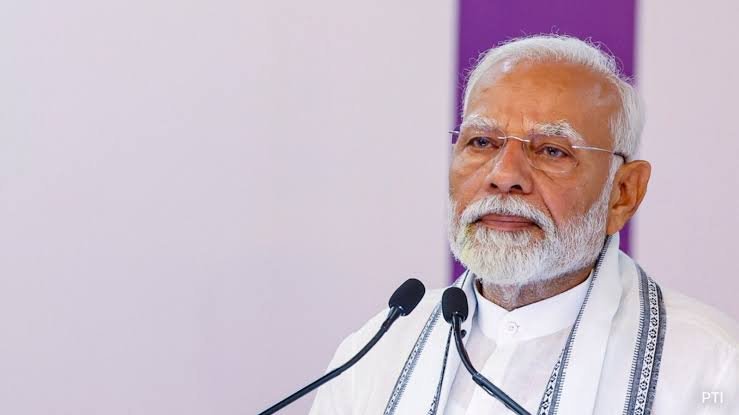
In the cultural and political ethos of contemporary India, milestone anniversaries serve as more than mere calendar markers; they function as reflective lenses through which the nation evaluates the trajectory of its leadership. Marking twenty-five consecutive years of executive administration, Prime Minister Narendra Modi stands as a singular figure in modern democratic history. To trace his journey is to examine an unprecedented political evolution that began in the autumn of 2001 in Gandhinagar and expanded across the vast landscape of the Indian Union. This quarter-century tenure has fundamentally altered the grammar of governance, shifting the paradigm from incremental bureaucracy to systemic reinvention.
The Crucible of 2001: Forging a New Administrative Philosophy
When Narendra Modi assumed office as the Chief Minister of Gujarat in October 2001, he inherited a state paralyzed by crisis. The monumental Bhuj earthquake had devastated infrastructure, the exchequer was deeply depleted, and institutional paralysis had crippled public administration. For a conventional politician, the conditions were primed for cautious, damage-controlling incrementalism. Modi, however, recognized that superficial repairs would yield only superficial stability. He treated the disaster as a blank slate for structural reinvention, establishing a governance template that would define his entire career: break the status quo relentlessly.
This early crucible taught him that realpolitik and principled economic decisions are not mutually exclusive, but rather mutually reinforcing. Gujarat became the testing ground for a new administrative doctrine where governance was no longer viewed through the lens of patronage and appeasement, but through efficiency, asset creation, and accountability.
Disrupting Power Dynamics: The Jyotigram Yojana Paradigm
Perhaps the clearest manifestation of this philosophy was the implementation of the Jyotigram Yojana. For decades, India’s rural electrification policy was marred by populist posturing, systemic corruption within state electricity boards, and the tacit acceptance that the “promise” of power was politically more lucrative than its “actual supply.”
Modi systematically dismantled this entrenched nexus by uncoupling agricultural power from local political maneuvering. By guaranteeing 24-hour three-phase power to non-agricultural rural consumers while rationing agricultural supply through dedicated feeders, he demonstrated a radical political truth: effective, tangible delivery could be converted into a powerful election-winning mechanism. This policy broke the age-old myth that developmental pragmatism runs counter to electoral populism, proving instead that governance performance could become the ultimate vote-catcher.
Economic Nationalism and the Investment Culture Shift
The launch of the Vibrant Gujarat Global Summit in 2003 represented another tectonic shift in national political discourse. Historically, states viewed economic development through the narrow prism of central allocations and sluggish public sector outlays. Modi tapped into Gujarat’s massive global diaspora and transformed it into an aspirational domestic political narrative.
Securing MoUs worth over fourteen billion USD at a state-level event in its nascent years was viewed by cynics as an impossible ambition. Yet, this initiative permanently altered federal competition in India. Today, states from Rajasthan and Uttar Pradesh to Maharashtra and Assam aggressively compete to attract foreign and domestic capital through investor summits. The evolution of this concept culminated in the 2024 edition of the summit, which attracted an astonishing 41,299 project MoUs representing approximately $315 billion in proposed investments. While critics frequently debate actual conversion rates, even a fraction of realization injects unprecedented capital momentum into regional economies.
The Art of Political Longevity and Direct Connection
Beyond structural reforms and macroeconomic milestones, the most remarkable facet of Modi’s twenty-five-year reign is his enduring political dominance. Achieving undisputed pre-eminence as the Bharatiya Janata Party’s premier leader over a span that now extends twelve years at the national level requires a sophisticated, highly adaptable skill set.
This resilience is anchored in an unmediated connection with the electorate. While critics often point to his avoidance of traditional press conferences, Modi mastered the art of direct communication long before digital media dominated political strategy. By leveraging radio broadcasts, massive physical rallies, and immersive digital ecosystems, he bypassed traditional intermediaries to forge an intimate bond with hundreds of millions of citizens. This direct line of communication remains a masterclass in modern political marketing.
The Contemporary Imperative: Engaging the Digital Generation
Despite his unmatched dominance, the Prime Minister faces a distinct generational challenge. A rapidly growing demographic of young Indians has no lived memory of the administrative decay that characterized pre-2001 Gujarat or the systemic policy paralysis of the early 2010s. For this cohort—whose political consciousness is forged through Instagram reels, algorithmic feeds, and rapid-fire digital content—leadership is evaluated through an entirely different framework.
To maintain his resonance, this new generation demands continuous, unfiltered engagement and visibility within unscripted environments. Given Modi’s historical track record of identifying structural bottlenecks and executing swift course corrections, bridging this generational gap through innovative, transparent engagement is the next logical frontier of his political evolution.
Ultimately, the quarter-century journey of Narendra Modi encapsulates a masterclass in strategic statecraft. By reading the pulse of an aspirational populace, relentlessly challenging institutional inertia, and consistently outmaneuvering his political rivals, he has fundamentally reshaped the nation’s destiny, leaving an indelible imprint on the fabric of Indian democracy.
