

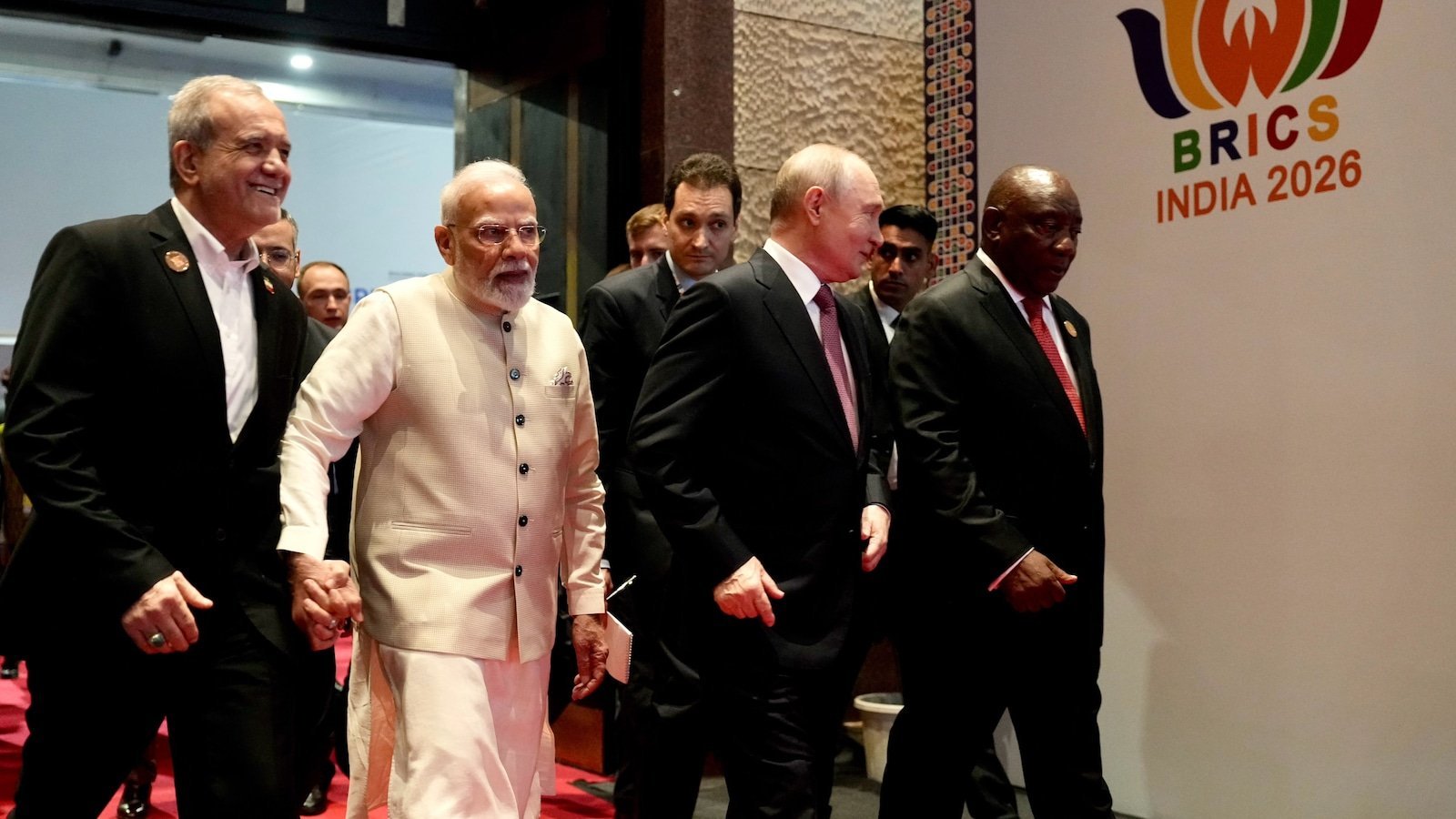
As world leaders gather in New Delhi for the 2026 BRICS Summit, a close examination of member motivations reveals a complex landscape of multi-alignment, economic pragmatism, and shifting global power dynamics. Originally founded in the wake of the 2008 financial crisis to reform global financial governance, the bloc now navigates heightened geopolitical tensions, energy shocks, and trade fragmentation.
Country-Specific Motivations Within BRICS
-
Russia: Driven heavily by Western sanctions following the Ukraine conflict, Moscow views BRICS as a vital economic lifeline. With roughly 35% to 40% of its global trade conducted with BRICS nations—about 90% of which is in national currencies—the bloc helps Russia break diplomatic and economic isolation while maintaining essential bilateral trade partnerships.
-
China: As the most powerful and economically dominant member, Beijing leverages BRICS to expand its international standing and bolster intra-BRICS trade. However, China remains deeply integrated with Western economies—maintaining extensive trade ties with the United States—balancing its leadership within the bloc against broader global commercial interests.
-
The UAE and Saudi Arabia: Gulf nations participate in BRICS to diversify diplomatic and economic alliances away from absolute reliance on the traditional US petrodollar system. While the UAE actively engages across all pillars—including financial cooperation and technology—Saudi Arabia practices “positive neutrality,” balancing its involvement in BRICS initiatives alongside massive bilateral economic and security commitments with the West.
-
Other Members (Brazil, South Africa, Egypt, Ethiopia): Brazil utilizes the bloc to expand agricultural exports and secure crucial Russian fertilizers via local currency frameworks. Egypt and Ethiopia lean into BRICS to ease hard currency pressures, leverage development bank financing, and signal strategic autonomy to Western partners.
India’s Core Agenda and Global Priorities For India, the summit serves as a platform to steer BRICS back to its original mandate of achieving an even playing field in the global economy and reforming multilateral institutions. Key Indian priorities include:
-
Climate Finance: Championing the Baku-to-Belém Roadmap to scale climate financing toward $1.3 trillion annually by 2035, ensuring developing nations are supported through the energy transition.
-
Counter-Terrorism: Pushing for faster information sharing, financial tracking, asset recovery mechanisms, and standardized legal processes.
-
Economic Resilience: Advancing the Strategy for BRICS Economic Partnership 2030 to safeguard farmers’ interests and uphold a rules-based trading order through the WTO.
Ultimately, while de-dollarization trends and national currency settlements continue to grow—largely catalyzed by global tariffs and conflicts—BRICS operates primarily as a platform for practical economic multi-alignment rather than a unified anti-Western bloc.
