

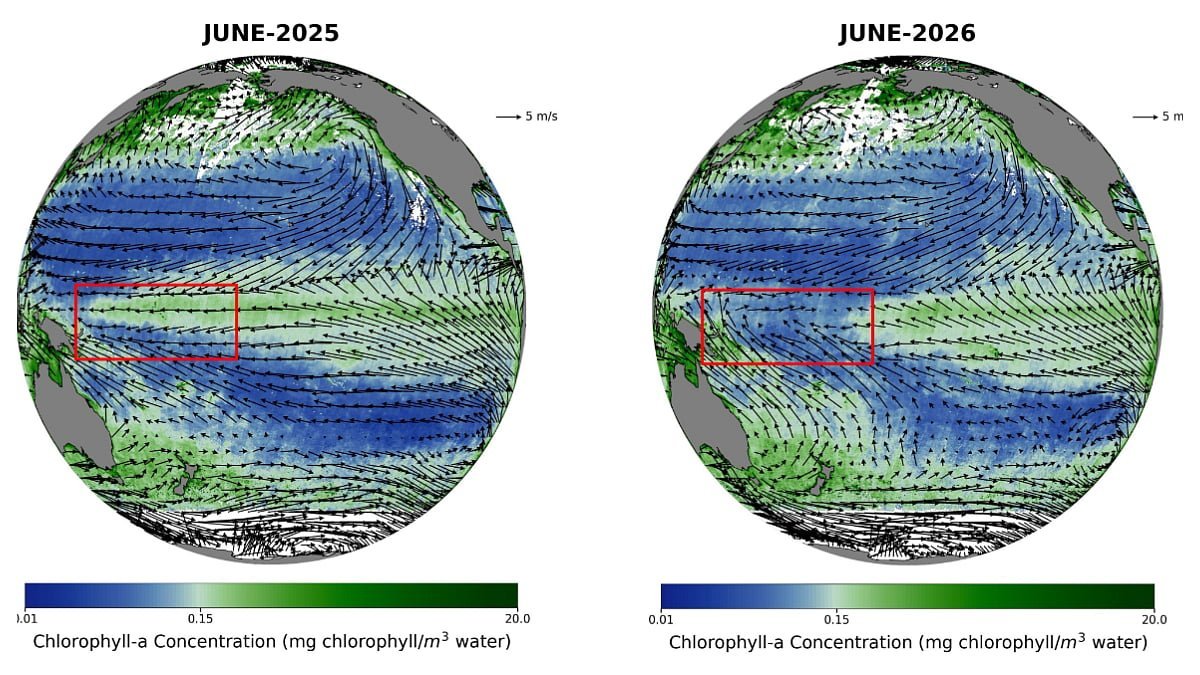
Data captured by the Indian Space Research Organisation’s EOS-06 (Oceansat-3) satellite has provided what scientists describe as some of the clearest early fingerprints of a strengthening El Niño. Operating from a 741-kilometer orbit, the satellite is tracking biological and physical shifts across the equatorial Pacific Ocean that complement outlooks from the World Meteorological Organization (WMO).
Key Scientific Findings from EOS-06
-
Chlorophyll-Depletion as an Early Indicator: According to analysis by ISRO’s National Remote Sensing Centre (NRSC), observations revealed a sharp decline in surface chlorophyll-a—the pigment found in microscopic phytoplankton that form the base of the ocean food chain. Because phytoplankton respond almost immediately to changes in ocean dynamics, this biological shift offers an earlier warning signal than traditional sea surface temperature (SST) indices.
-
Wind Reversals: The satellite’s onboard Scatterometer simultaneously detected a reversal of ocean surface winds from easterlies to westerlies, a classic mechanical precursor to El Niño development.
-
Mechanics of the Shift: Dr. Prakash Chauhan, Director of ISRO’s NRSC, explained that warming waters in the eastern Pacific suppress the upwelling of colder, nutrient-rich deep ocean waters, causing phytoplankton growth to collapse—a change clearly captured by the satellite’s Ocean Colour Monitor.
Global and Regional Implications
-
WMO Alignment: The WMO has indicated an 80% probability of El Niño conditions persisting and strengthening through late 2026 and into early 2027, raising global concerns over extreme weather and elevated temperatures.
-
Monsoon Watch for India: Because El Niño events are historically linked to weakened southwest monsoon rainfall and potential agricultural stress across the Indian subcontinent, real-time monitoring via the dual instruments on EOS-06 provides a critical early detection mechanism for agricultural planning and water resource management.
