

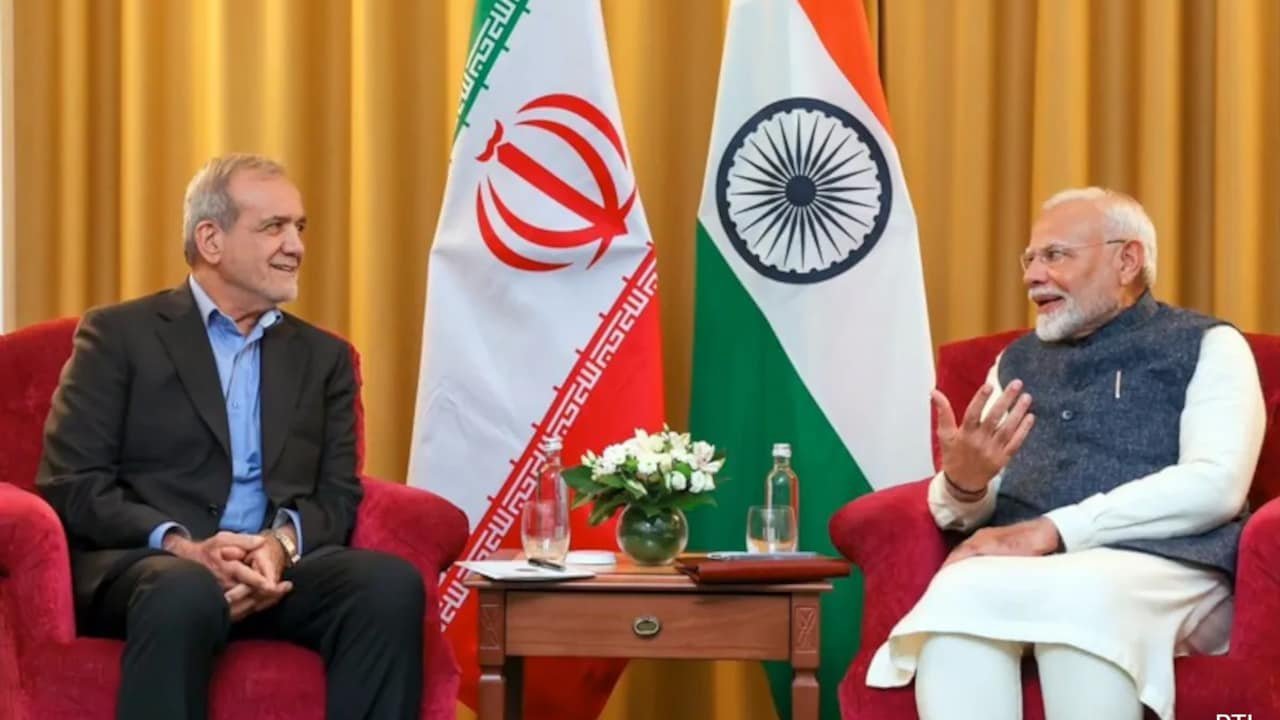
Prime Minister Narendra Modi’s recent meeting with Iranian President Masoud Pezeshkian on the sidelines of the Shanghai Cooperation Organisation (SCO) Summit in Bishkek has underscored a resolute foreign policy reality: India’s strategic autonomy remains non-negotiable.
The high-level engagement took place despite intense geopolitical friction and direct warnings from Washington. Earlier, US Treasury Secretary Scott Bessent warned that nations trading with Iran would face secondary sanctions on their exports to the US, while President Trump’s “Operation Economic Outcast” threatened countries engaging with Tehran with a 25% tariff on all exports shipped to the United States. Following the Bishkek meeting, US Secretary of State Marco Rubio reiterated that no country should help Iran evade sanctions without facing punitive measures.
Notwithstanding these warnings, Prime Minister Modi took to social media to affirm India’s position, stating his desire to expand and diversify bilateral trade across diverse sectors and support regional peace efforts. This defiant diplomatic posture will be further cemented when President Pezeshkian arrives in New Delhi for the upcoming BRICS Summit on September 12–13.
The Historical Tightrope: From Obama-Era Waivers to Chabahar
India’s balancing act with Iran has a deep historical precedent. Under the 2012 US National Defense Act, New Delhi successfully negotiated waivers by scaling back its oil imports. Later, during the Trump administration’s “maximum pressure” campaign in 2018–19, India was forced to reduce its Iranian crude imports to zero once temporary Significant Reduction Exceptions expired.
More recently, geopolitical shifts have impacted strategic infrastructure projects like the Chabahar Port. While a special US carve-out waiver initially allowed Indian companies to develop the Shahid Beheshti terminal—serving as a vital trade corridor to landlocked Afghanistan—that waiver expired under renewed sanctions enforcement. Although India has temporarily paused operations at Chabahar to avoid secondary sanctions, New Delhi views the port as its permanent “gateway” to Central Asia and Eurasia, ready to be revived when conditions permit.
Navigating West Asian Realities and Energy Security
The calculus of engaging Tehran goes far beyond simple bilateral trade. The six-month conflict involving the US, Israel, and Iran has fundamentally reoriented West Asian geopolitics, demonstrating that no durable security framework in the region can bypass Iranian participation.
For India, the region remains an irreplaceable lifeline:
-
Energy Anchor: West Asia supplies 40–45% of India’s crude oil, 50–60% of its LNG imports, and the vast majority of its imported cooking gas.
-
Economic Ties: The Gulf Cooperation Council (GCC) constitutes India’s largest regional trading block, with annual trade exceeding $175 billion.
-
Expatriate Diaspora: Nearly 9 million Indian nationals live and work in the Gulf, driving remittances that account for over $40 billion annually.
A Masterclass in Strategic Restraint
In fewer than 50 words following the Bishkek meeting, New Delhi communicated a sophisticated message across multiple fronts. To Tehran, it offered reassurance of a reliable, independent partnership. To Washington and Tel Aviv, it signaled that India’s diplomatic horizons are broad and resilient. And to the Global South, it positioned India as a mature, steady advocate for regional stability.
By refusing to bow to external coercion and maintaining open channels of communication, India has once again demonstrated that while foreign powers can issue threats, they cannot dictate the terms of its sovereign foreign policy.
