

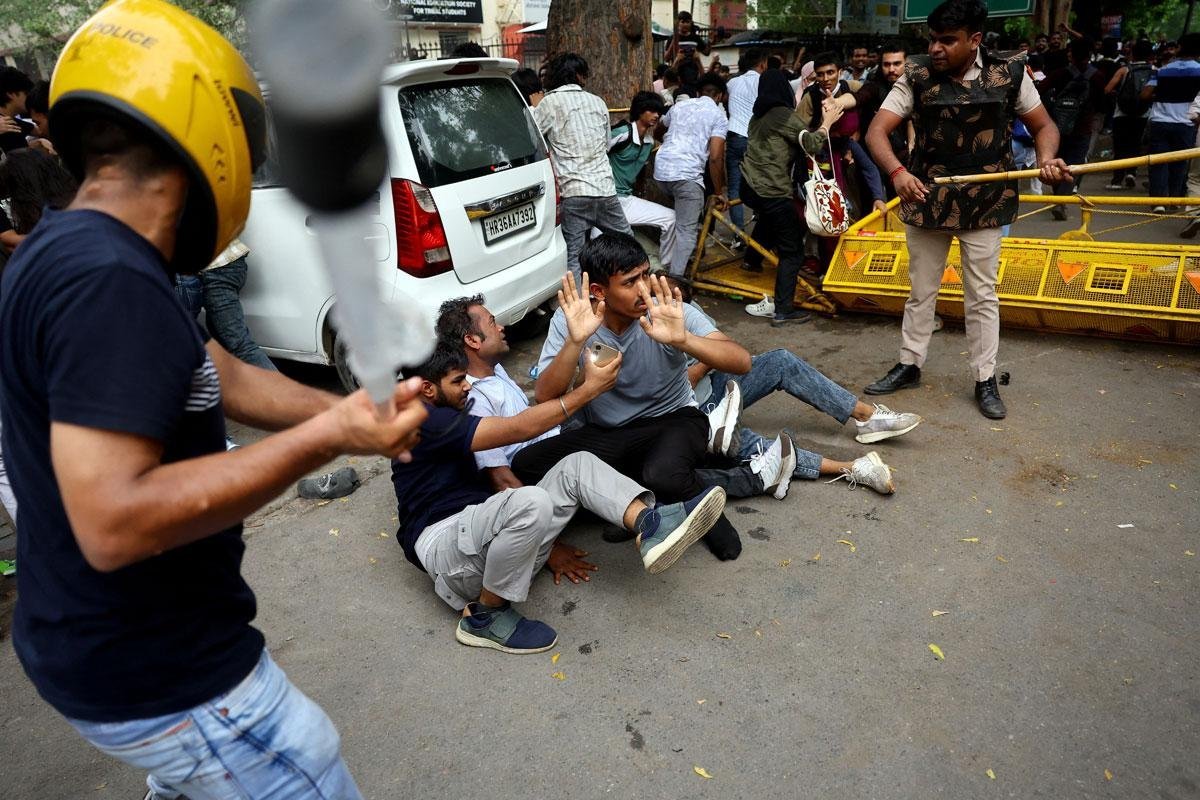
Supreme Court judge Justice Ujjal Bhuyan delivered a searing critique of law enforcement conduct during public demonstrations, asserting that the impartiality and psychological detachment traditionally demanded of police officers are visibly eroding. Speaking at the capital’s Viceroy Hall during the release of veteran security expert and retired IPS officer Yashovardhan Azad’s book, Policing the Republic, Justice Bhuyan expressed deep consternation over witnessing young Indian Police Service (IPS) officers directly engaging in the physical assault of student demonstrators and civic protesters.
The jurist’s observations directly address the heavy-handed security crackdowns that transpired during student-led demonstrations at New Delhi’s Jantar Mantar and the subsequent parliamentary march. These widespread protests—sparked by profound public outrage over systemic administrative failures and examination paper leaks—drew thousands of students to the national capital. The resulting confrontations with law enforcement agencies generated acute national controversy, culminating in judicial intervention as accounts and visual evidence of severe police violence emerged.
Emphasizing that an ordinary citizen identifies the majesty and protection of the state through the presence of a law enforcement officer, Justice Bhuyan warned that institutional credibility is severely compromised when personnel abandon restraint. Effective public order, he noted, can be successfully maintained without defaulting to abusive tactics, excessive force, or the direct violation of fundamental human rights.
Expanding his critique beyond street-level demonstrations, the Supreme Court judge addressed the systemic scourge of custodial violence and deaths, categorizing them among the most egregious crimes possible within a constitutional democracy governed by the rule of law. He underscored that state functionaries who unlawfully resort to torture, cruel or degrading treatment, or extra-judicial measures effectively position themselves as lawbreakers, thereby breeding widespread contempt for the legal framework and precipitating institutional lawlessness. Reaffirming established jurisprudence—including landmark benchmarks from 2011 regarding extra-judicial executions—Justice Bhuyan reiterated that the normalization of “encounter philosophies” is fundamentally antithetical to a civilised society and nullifies the core tenets of constitutional governance.
These judicial strictures parallel ongoing institutional checks by the apex court, which established a high-powered independent committee headed by former Supreme Court judge Justice R. Subhash Reddy. This judicial panel is tasked with meticulously examining comprehensive evidence—including digital recordings, CCTV feeds, and medical reports—concerning the deployment of heavy kinetic projectiles, tear gas, electric batons, and allegations of targeted harassment against vulnerable protesters.
