

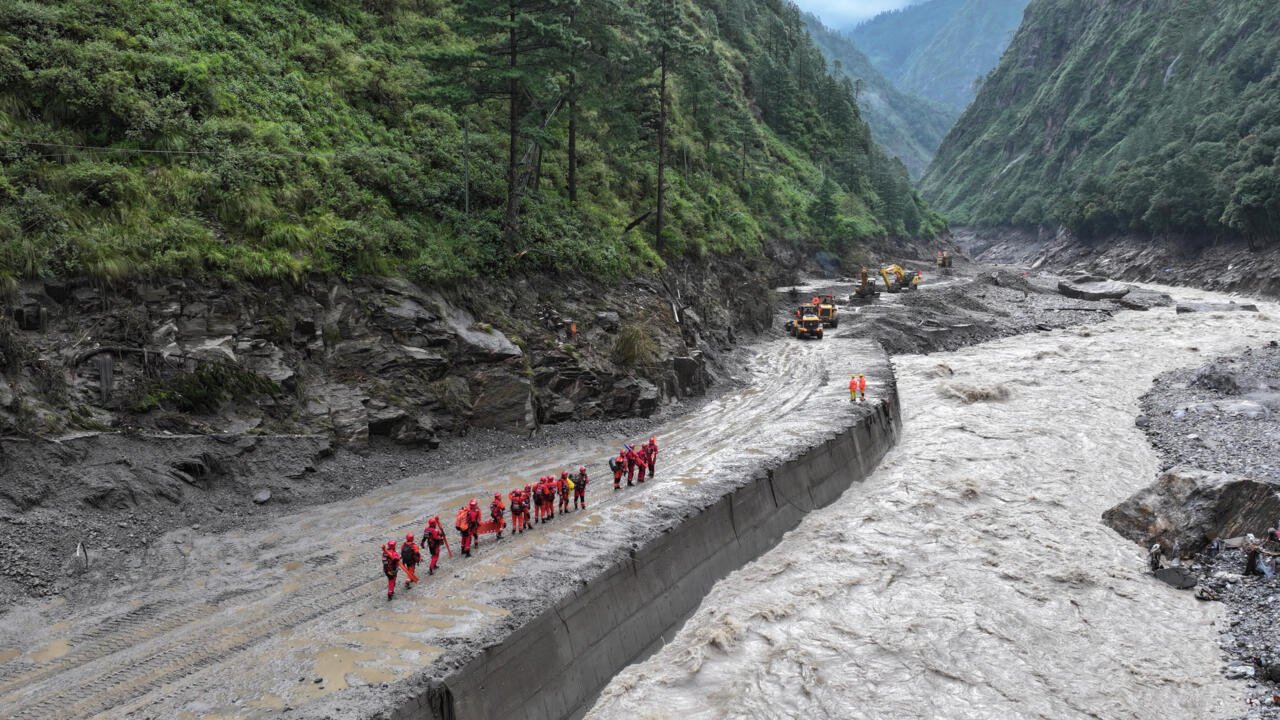
Massive flash floods triggered by a sudden glacial collapse near the Nepal-Tibet border have killed hundreds of people and left over 2,000 missing across the Himalayan region, marking Nepal’s worst natural disaster since the catastrophic 2015 earthquake.
Search and rescue operations are proceeding at full scale, with over 14,000 security personnel deployed in affected districts. Rescuers have pulled nearly 3,750 survivors from flooded valleys, but unstable terrain and secondary flood warnings continue to hamper efforts.
A Glacial Avalanche and Secondary Dam Breaches
The disaster began Wednesday when a massive ice-and-rock avalanche collapsed in the higher Himalayan reaches along the Nepal-China border. The US Geological Survey noted that the collapse generated seismic waves equivalent to a 5.2-magnitude tremor, releasing a torrent of ice, mud, and water that swept through settlements along the Trishuli and Bhote Koshi rivers.
Complicating the response, debris blocked mountain rivers upstream, creating unstable barrier lakes. Nepalese police issued emergency alerts following reports of a breach in a Tibetan dam, urging personnel and local communities along riverbanks to evacuate immediately to higher ground.
Status of Indian Nationals and Rescue Operations
At a press briefing in New Delhi, External Affairs Ministry spokesperson Randhir Jaiswal confirmed that 84 Indian nationals have been evacuated so far, including 21 tourists from Kathmandu and 63 workers trapped at the Trishuli-1 hydropower project. Another group of nearly 100 Indians stranded on the Chinese side successfully crossed back into Nepal by land.
However, significant concerns remain:
-
Missing Citizens: Approximately 320 Indian nationals remain uncontactable in Nepal, alongside 100 non-resident individuals of Indian origin traveling on foreign passports.
-
Stranded Pilgrims: Around 400 Indian pilgrims undertaking the Kailash Mansarovar Yatra remain stuck on the Tibetan side of the border. Officials confirmed they are safe and in active communication with embassy teams.
Emergency Relief Efforts
India has dispatched over 50 tonnes of emergency relief materials to Nepal across multiple military aircraft. The cargo includes water purification systems, portable power generators, food, tents, and essential medical supplies.
An 11-member specialized medical team and tunnel-rescue experts have also arrived in Kathmandu to assist Nepalese authorities with complex subterranean rescues at damaged infrastructure sites.
