

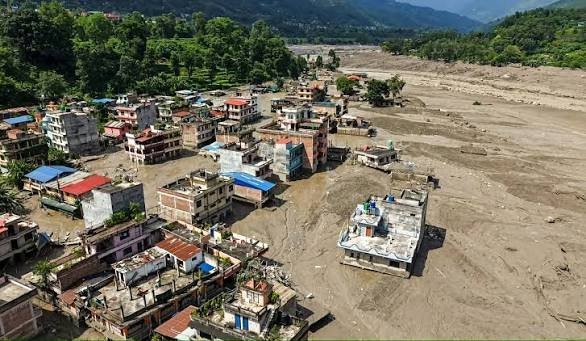
The Himalayas—spanning India, Nepal, China, and Bhutan—represent one of the most ecologically fragile and critical life-support systems on Earth, sustaining the freshwater security and climatic stability for roughly two billion people. Recent events, including sudden cross-border flash floods originating near the Nepal-China border and cascading down transboundary rivers like the Gandak and Kosi into Uttar Pradesh and Bihar, highlight the urgent need for a coordinated regional framework.
1. Key Structural Vulnerabilities
-
Glacial Melt & Climate Acceleration: Rapid warming in high-altitude zones is accelerating glacier retreat, threatening long-term river flows and freshwater availability.
-
Transboundary Flash Floods: Sudden cloudbursts or glacial lake outburst floods (GLOFs) in upper catchments pose an immediate, high-speed danger to downstream populations in the Gangetic plains.
-
Anthropogenic Pressures: Unscientific riverbed mining, deforestation, and heavy infrastructure projects compound natural ecological fragilities.
2. The Shift Toward Ecological Diplomacy
-
Beyond Geopolitics: Policymakers and regional leaders are increasingly arguing that traditional diplomatic and civilisational frameworks (such as cultural or historical ties) must be complemented by formal ecological cooperation.
-
Four-Nation Coordination: Because weather systems, river basins, and mountain ranges ignore international boundaries, effective disaster mitigation and climate adaptation require collaborative intelligence, early-warning data sharing, and joint environmental protection standards between India, China, Nepal, and Bhutan.
