

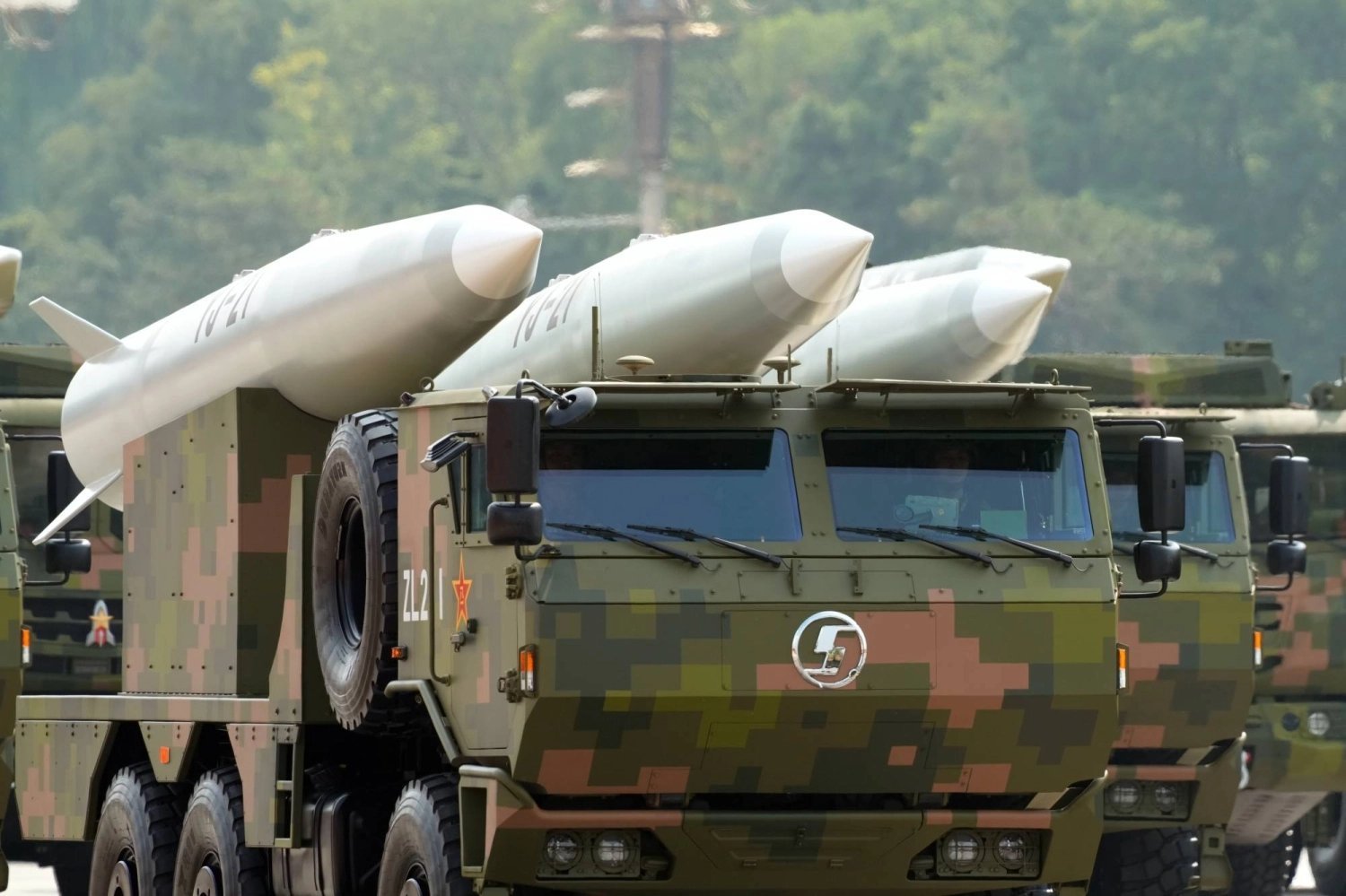
China has developed hypersonic glide vehicles (HGVs) capable of launching air-to-air missiles over extreme distances, targeting high-value military assets thousands of miles away.
This development places high-value U.S. and allied support aircraft—such as airborne early warning and control (AEW&C) planes, aerial refueling tankers, and airborne command posts like the U.S. Air Force’s E-4B Nightwatch—within potential strike ranges.
Key Technical Details & Capabilities
-
Unique Operational Capability:
-
China is currently the only nation publicly known to operate and develop HGVs capable of launching air-to-air weaponry.
-
HGVs travel at speeds greater than Mach 5 and maneuver within the atmosphere, making trajectory prediction and interception exceptionally difficult.
-
-
Missile Platforms & Operational Ranges:
-
DF-17 Missile: Deploys HGVs with an estimated range of ~2,414 kilometers (~1,500 miles), reaching near U.S. strategic locations like Guam.
-
DF-27 Missile: Features an estimated range of up to 8,000 kilometers (~5,000 miles), bringing targets as far as Hawaii within operational reach.
-
-
Strategic Threats to U.S. Operational Architecture:
-
Designed to disrupt critical “kill chains” by eliminating non-stealthy support aircraft (tankers, radar command posts) that fighters and bombers rely on to sustain long-range operations in the Indo-Pacific.
-
Tactical Challenges & Operational Risks
-
Extended Target Tracking (The “Kill Chain”): At maximum ranges, a ballistic or hypersonic boost phase can take 20 minutes or longer to reach the target area. This demands continuous, highly accurate, real-time targeting data, which remains susceptible to electronic countermeasures and radar disruption.
-
The “Discrimination Problem”: Launching a heavy ballistic-missile-derived booster during high-intensity hostilities carries the inherent risk of being misidentified by early-warning systems as a nuclear launch, potentially provoking inadvertent escalation.
Global Long-Range Air-to-Air Weapon Comparison
| Country / Region | Weapon System | Developer / Manufacturer | Key Specs / Features | Status |
| China | HGV-Launched Air-to-Air Missiles (DF-17 / DF-27 Boosters) | State Defense Sector |
• Range: ~2,400 km to 8,000 km • Speed: Hypersonic (Mach 5+) |
In Active Development / Deployed |
| United States | AIM-174B | RTX Corp. |
• Adapted from the SM-6 platform • Designed for standoff fleet defense |
Active / Testing |
| United States | AIM-424 Malice | Raytheon (RTX) |
• Range: 300+ miles (480+ km) • Long-range air superiority |
Under Testing |
| United States | AIM-260 JATM | Lockheed Martin |
• Next-gen air-to-air missile • Replaces older AIM-120 AMRAAMs |
In Production |
| Europe | Meteor | MBDA Systems |
• Range: 100+ miles (160+ km) • Ramjet-powered air-to-air missile |
Operational |
Next Steps & Further Information
-
To read official technical assessments regarding foreign aerospace capabilities, visit the USAF China Aerospace Studies Institute (CASI).
-
For public defense procurement and strategic reports, consult the U.S. Department of Defense Official Portal.
