

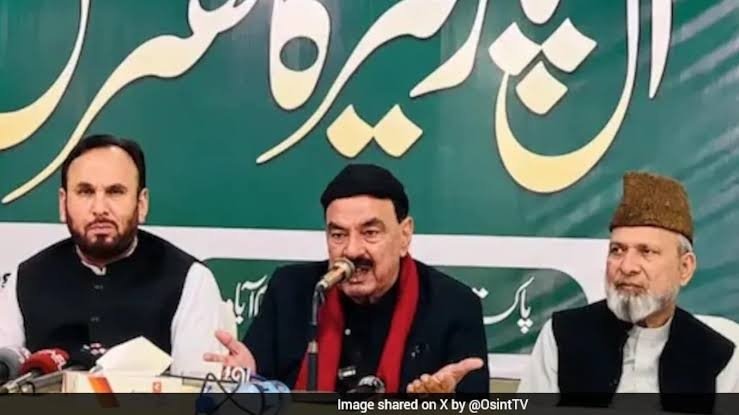
Sheikh Rasheed Ahmed, who served as Pakistan’s Interior Minister from 2020 to 2022 under the Imran Khan administration, has sparked outrage after openly praising UN-designated global terrorist and Lashkar-e-Taiba (LeT) founder Hafiz Saeed at a public event. During his address, the Awami Muslim League leader also directed unprovoked threats toward India.
Sharing Stage with LeT Leaders
A video circulating widely on social media captures Rasheed on stage alongside prominent figures connected to the banned terror outfit:
-
Khalid Masood Sandhu: Senior LeT commander and President of the Pakistan Markazi Muslim League (PMML).
-
Qari Muhammad Yaqoob Sheikh: Key operative associated with the terror group.
Addressing the gathering, Rasheed explicitly pledged his allegiance to the LeT founder, stating:
“Main Hafiz sahab ka ghulam hu” (I am a slave of Hafiz Saeed).
Rasheed further claimed that he was once deported from the United States because authorities found Hafiz Saeed’s phone number saved in his personal contacts.
Inflammatory Remarks and Threats Against India
Beyond declaring support for Saeed, the former minister issued hostile rhetoric aimed at India:
-
Aggressive Warnings: Claimed that divine intervention would “destroy” India if it attempted any action against Pakistan.
-
Inflammatory Rhetoric: Asserted that “no birds will chirp in India, nor will bells ring in a temple” while alleging that anti-Pakistan activities would not be tolerated.
-
Institutional Ties: Explicitly stated, “We are with Pakistan, with Hafiz Saeed,” reinforcing concerns over mainstream political patronage of proscribed terror figures.
A History of Controversial Disclosures
This is not the first time Rasheed’s public statements have drawn international attention to Islamabad’s internal political dynamics and terrorism history. During his tenure as Interior Minister in 2022, he publicly claimed that former Prime Minister Nawaz Sharif had previously disclosed the Pakistani origin (Faridkot) of 26/11 Mumbai attacker Ajmal Kasab to Indian authorities—a statement aimed at discrediting domestic political opponents at the time.
Rasheed’s latest open endorsement of Hafiz Saeed once again undercuts Islamabad’s official position regarding non-state actors operating within its borders.
