

On a day that was supposed to belong to parliamentary procedures marking the beginning of the Monsoon Session, the streets of the national capital instead bore witness to an extraordinary convergence of civil unrest. From systemic student rage over paper leaks to a historic political march by a serving Chief Minister, New Delhi became the stage for two distinct but explosive movements, even as the global sports world reeled from Argentina’s dramatic World Cup heartbreak.
Wangchuk Defiant as “Gen Z” Protest Spirals Into Street Clashes
Inside Safdarjung Hospital, climate activist and educator Sonam Wangchuk entered the 23rd day of his indefinite hunger strike. Wangchuk, who joined the youth-led agitation on June 28, issued a signed, handwritten note through his wife, Gitanjali Angmo, declaring that he will not break his fast despite a high-profile meeting between government ministers and protest leaders.
Wangchuk had previously laid out clear terms to end his strike: a formal acknowledgement of systemic failures by the Ministry of Education, or an assurance from parliamentarians—delivered either at the gates of Parliament or directly to his hospital bed—that the issue would be thoroughly debated. Following what he described as police “brutality” against peaceful marchers, his resolve has only hardened.
“I have decided to continue my fast until the youth leaders are allowed to meet the Parliamentarians at the Sansad Bhawan or I am allowed to meet them here at the hospital,” Wangchuk’s note read.
The agitation is being spearheaded by the Cockroach Janta Party (CJP), a satirical youth movement that has mutated from a viral social media phenomenon into a potent street-level political force. Founded in May 2026 by public relations graduate Abhijeet Dipke in response to controversial remarks made by the Chief Justice of India, the CJP rapidly amassed an astonishing 22 million online followers—briefly eclipsing the ruling BJP’s digital footprint.
The group has channeled widespread anger over recurring national examination scandals, specifically the NEET-UG paper leaks, demanding the immediate resignation of Union Education Minister Dharmendra Pradhan.
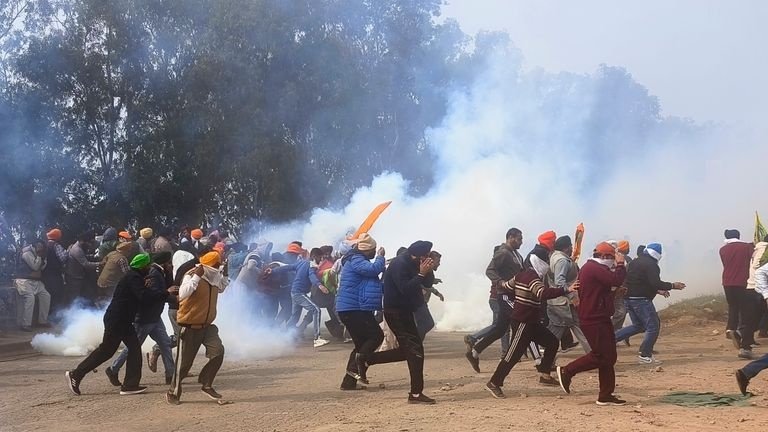
The tension culminated on Monday as thousands of students attempted a “Sansad Chalo” (March to Parliament). Central Delhi was effectively transformed into a fortress, with 32 companies of paramilitary forces deployed, five major metro stations shuttered, and police firing tear gas near Shastri Bhawan to disperse crowds attempting to breach barricades.
While Union Minister J.P. Nadda held an eleventh-hour meeting with CJP spokespersons Saurav Das and Ashutosh Ranka to receive their charter of demands, the deadlock remains unresolved. Simultaneously, the Delhi High Court intervened, demanding complete clinical records from Safdarjung Hospital amid an appeal by Wangchuk’s family challenging his placement there, which they have labeled an “illegal detention”.
A First in Political History: Omar Abdullah Takes to the Streets
Just a short distance from the student chaos at Jantar Mantar, a separate, historic political demonstration unfolded. In an unprecedented move, Jammu & Kashmir Chief Minister Omar Abdullah—alongside dozens of J&K ministers and MLAs—actively took to the streets of New Delhi to demand the immediate restoration of J&K’s statehood.
It marks the first time in history that a serving Chief Minister of Jammu and Kashmir has participated in a street protest of this nature. Marching alongside him was his father, 89-year-old National Conference President Farooq Abdullah, who marched resolutely with the help of a walking stick.
Taking a direct swipe at regional opponents who chose to stay away from the physical protest, Omar Abdullah noted, “Here is a 90-year-old man leading from the front for J&K’s rights and dignity while some others sit at home posting tweets.”
The J&K leadership alleged that they were actively blocked by Delhi Police from peacefully accessing their designated protest site at Jantar Mantar, forcing the demonstration into adjacent roads. In the ensuing logistical chaos and surging crowds, Abdullah—a Z-plus protectee—temporarily abandoned his official security convoy to hail a local auto-rickshaw to navigate through the cordoned-off streets of the capital.
“This is only the beginning of our struggle for statehood, our rights, our dignity, and everything that was taken away from us,” Abdullah posted on X, referencing the Union government’s landmark 2019 decision to revoke Article 370.
Global Echoes: Defeat in New Jersey Filters into the Capital
The highly charged domestic atmosphere in Delhi matched the somber mood filtering through the sports world, as news of the 2026 FIFA World Cup Final finality settled over fans. In a grueling, high-stakes showdown at MetLife Stadium in East Rutherford, Spain captured the World Cup trophy with a dramatic 1-0 victory over Argentina, courtesy of a 106th-minute extra-time goal by Ferran Torres.
The match marked a heartbreaking, bittersweet curtain call for Lionel Messi, who suffered a profound career low in his final World Cup appearance, unable to carry his side past an impenetrable Spanish defense.
Between the volatile scenes on the streets of New Delhi and the emotional weight of global sporting transitions, the opening of the Monsoon Session has set a remarkably tense, unpredictable tone for the weeks ahead.
