

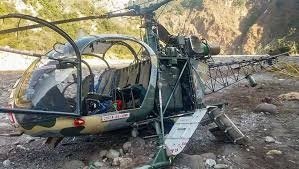
Three Indian Army officers, including a senior commander, miraculously survived after their helicopter crashed in the rugged, high-altitude terrain of Ladakh. The incident occurred on May 20 in the mountainous Tangste region near Leh, with defense officials officially confirming the details today.
What has truly captured the public’s attention is a viral, post-crash selfie taken by the senior officer on board. The image shows the three men resting on boulders with the heavily mangled remains of the single-engine aircraft directly behind them—a testament to an incredibly narrow escape.
The Details of the Incident
The helicopter was executing a high-altitude flight when it went down in the treacherous terrain. The occupants on board included:
-
Passenger: Major General Sachin Mehta, the General Officer Commanding (GOC) of the 3rd Infantry Division.
-
Pilots: A Lieutenant Colonel and a Major, who were steering the aircraft.
Despite the impact severely destroying the helicopter, all three officers managed to escape with relatively minor injuries. Aviation experts and military personnel have dubbed their survival a complete “miracle” given the hostile, low-oxygen mountainous environment. A formal inquiry has been ordered to ascertain the exact cause of the crash.
Safety Concerns Mount Over the Ageing Cheetah Fleet
The Ladakh crash has renewed the fierce, ongoing debate surrounding the safety and operational longevity of the Army’s Cheetah helicopter fleet.
While the five-seater Cheetah has historically been lauded as one of the finest high-altitude flying machines in the world—famously proving its mettle during Operation Meghdoot on the Siachen Glacier in 1984—the fleet is now decades old. Introduced in the 1970s, these vintage, single-engine choppers have been plagued by structural fatigue, leading to multiple fatal crashes over recent years.
The Path to Modernization: HAL’s Light Utility Helicopter (LUH)
To completely eliminate these safety risks, the Indian Army is actively phasing out the Cheetah fleet in favor of the Light Utility Helicopter (LUH). This indigenous aircraft is designed and manufactured by Hindustan Aeronautics Limited (HAL).
The Army has already placed orders for an initial batch of six limited-series-production LUHs. A comparison of the old fleet’s replacement highlights a massive technological leap forward:
| Capability | HAL Light Utility Helicopter (LUH) Performance |
| Top Speed | 220 km/h |
| Service Ceiling | 6.5 km (High-altitude optimized) |
| Operational Range | 350 km |
The transition aims to provide modern, twin-engine safety margins and improved cargo capabilities for troops stationed across India’s highly sensitive and demanding northern borders.
