

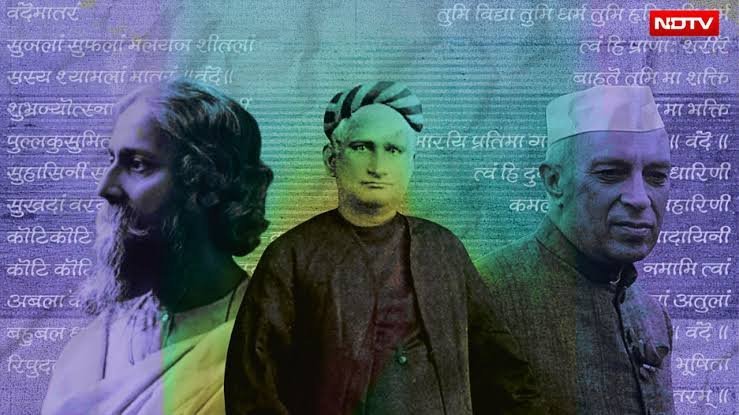
First written by Bankim Chandra Chattopadhyay in 1875 in Sanskritised Bengali and later integrated into his 1882 historical novel Anandamath, Vande Mataram has long stood as both a stirring anthem of liberation and a subject of intense political debate. The poem gained widespread national prominence after Rabindranath Tagore set it to music for the 1896 Calcutta Congress session, transforming its title into a defining battle cry against British colonial rule.
As the song expanded beyond Bengal, debate emerged surrounding its imagery and inclusion in public life:
-
Literary Context: Anandamath is set against the 18th-century Sanyasi Rebellion against British forces and local Muslim governors. Critiques have noted that parts of the novel fictionalized events in ways that drew communal lines.
-
Religious Imagery: While the opening stanzas depict a fertile, serene countryside, later stanzas directly evoke Hindu deities—identifying the motherland with Durga, Lakshmi, and Saraswati. Muslim leaders and scholars argued that singing these specific stanzas conflicted with strict monotheistic principles against idol worship.
-
The 1937 Congress Compromise: Facing growing divisions, Jawaharlal Nehru consulted Rabindranath Tagore in October 1937. Tagore noted that while the initial stanzas captured a spirit of devotion to the nation’s natural beauty, the later stanzas were explicitly rooted in Hindu iconography. The Congress Working Committee (CWC)—including Mahatma Gandhi, Subhas Chandra Bose, and Vallabhbhai Patel—subsequently resolved that only the first two stanzas would be sung at party events.
-
Constituent Assembly Decision: In January 1950, Constituent Assembly President Rajendra Prasad announced that Tagore’s Jana Gana Mana would serve as the National Anthem, while Vande Mataram was assigned equal status as the National Song.
Recent Legislative Changes and Political Friction
The debate resurfaced when Prime Minister Narendra Modi launched a year-long commemoration of the song’s 150th anniversary in November 2025. Following special parliamentary discussions in December 2025, the central government enacted updates to standard protocols and legal protections:
-
Protocol Mandate: Central government directives established that all six stanzas of Vande Mataram must be performed at official functions prior to Jana Gana Mana.
-
Statutory Protection: Parliament amended the Prevention of Insults to National Honour Act to extend the same legal protections to Vande Mataram as the National Anthem, making deliberate disruption of its rendition punishable by up to three years in prison.
-
Current Political Stance: While government leadership has framed the full six-stanza performance as fundamental to honoring the national song, the Congress Working Committee recently reiterated its 1937 resolution, maintaining that limiting public singing to the first two stanzas remains the most inclusive approach.
