

While terrestrial mobility focuses on electric drivetrains and autonomous systems, aviation is undergoing a parallel transformation focused on data-driven intelligence, improved operational efficiency, and next-generation propulsion architectures.
A visit to the GE Aerospace John F. Welch Technology Centre (JFWTC) in Bengaluru—one of the company’s largest multidisciplinary R&D facilities outside the U.S.—demonstrates how modern aircraft engines are evolving into connected, intelligent systems.
Key Areas Driving Next-Gen Aviation Propulsion
1. Artificial Intelligence and Predictive Maintenance
-
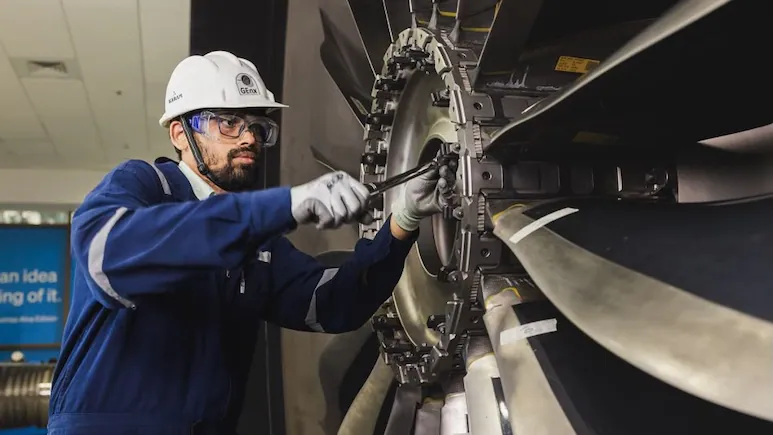
Blade Inspection Tool (BIT): AI-assisted visual inspection systems help technicians analyze turbine blades with higher consistency. For engines like the GEnx, BIT reduces inspection times by roughly 50%.
-
Analytics-Based Maintenance: Combining optical data with physics-based modeling enables condition-based maintenance. Predicting required repairs based on live performance metrics reduces turn-around time (TAT) at maintenance hubs by up to five days.
-
360 Foam Wash: Specialized washing routines remove particulate build-up from compressor blades to lower exhaust gas temperatures and restore compressor efficiency, improving visual inspection clarity.
2. Revolutionary Engine Architectures
-
CFM RISE Program: Managed jointly by GE Aerospace and Safran Aircraft Engines, the Revolutionary Innovation for Sustainable Engines (RISE) initiative aims to reduce fuel consumption and CO₂ emissions by 20% compared to current commercial turbofans.
-
Open Fan Design: By removing the traditional protective casing (nacelle), Open Fan architectures allow for significantly larger fan blades and higher bypass ratios without adding excessive weight or aerodynamic drag.
-
Hybrid-Electric Integration: The program is actively testing compact engine cores integrated with megawatt-class hybrid-electric powertrains and compatibility with 100% Sustainable Aviation Fuel (SAF) and hydrogen.
Comparison: Conventional Turbofans vs. Open Fan Architecture
| Feature | Current High-Bypass Turbofans | CFM RISE Open Fan Architecture |
| Enclosure | Ducted (encased in a metallic/composite nacelle) | Unducted (Open Fan) |
| Fuel Efficiency Goal | Baseline standard (e.g., CFM LEAP series) | +20% efficiency improvement |
| Bypass Ratio | Typically 10:1 to 12:1 | Significantly higher due to unconstrained fan diameter |
| Primary Focus | Reliable short-to-long haul commercial transport | Decarbonization, reduced drag, and enhanced durability |
India’s Growing Role in Global Aviation Engineering
India’s participation in global aviation extends beyond its expanding commercial market—which includes order books like IndiGo’s selection of over 1,000 CFM LEAP-1A engines.
At the GE Aerospace Bengaluru Centre, engineers contribute directly to core engine design, control software, power electronics, and analytics frameworks used in commercial engines globally. As propulsion architectures shift toward hybrid-electric and data-heavy systems, local research and development hubs are playing an integral role in shaping the next era of commercial flight.
