

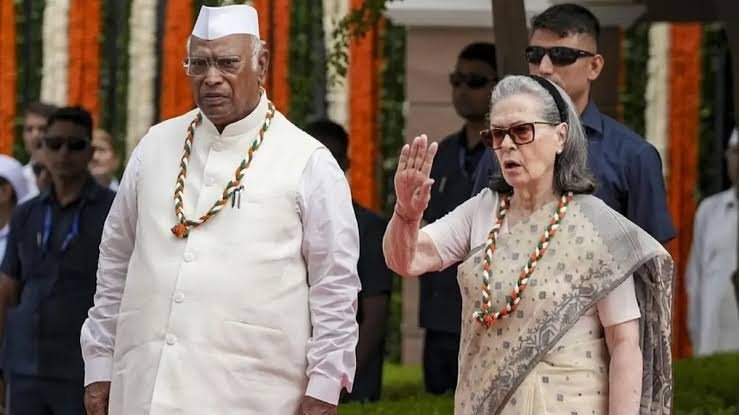
A political row broke out on Independence Day following claims by the Bharatiya Janata Party (BJP) that Congress leader Sonia Gandhi attempted to interrupt the full rendition of Vande Mataram during an event at the party’s headquarters in New Delhi. The Congress firmly rejected the allegation, clarifying that Gandhi was merely requesting a chair for party chief Mallikarjun Kharge.
BJP Accusations and Political Fallout
-
BJP Allegations: BJP spokesperson Sudhanshu Trivedi criticized senior Congress leaders—including Sonia Gandhi, Rahul Gandhi, and Mallikarjun Kharge—stating their behavior during the song was disrespectful and demonstrated an inability to accept the national song in its full form.
-
Amit Malviya’s Statement: BJP IT cell chief Amit Malviya alleged on X that Sonia Gandhi appeared agitated as the song continued beyond the initial stanzas and signaled for it to stop. He stated that the full version of Vande Mataram was ultimately completed in accordance with current legal mandates.
Congress Response and Background
-
Congress Clarification: The Congress emphasized that the national song was sung in full at the party office, explaining that Sonia Gandhi’s hand gestures were only intended to arrange seating for Mallikarjun Kharge, who had been standing for an extended period.
-
Historical & Legal Context: Written by Bankim Chandra Chatterjee in 1875, the first two stanzas of Vande Mataram were officially adopted as the National Song in 1937, while the remaining stanzas were excluded due to historical debates regarding their inclusion of religious imagery. The BJP-led central government mandated the singing of the song in its entirety earlier this year, supported by recent legislation establishing penalties for intentionally obstructing its rendition.
