

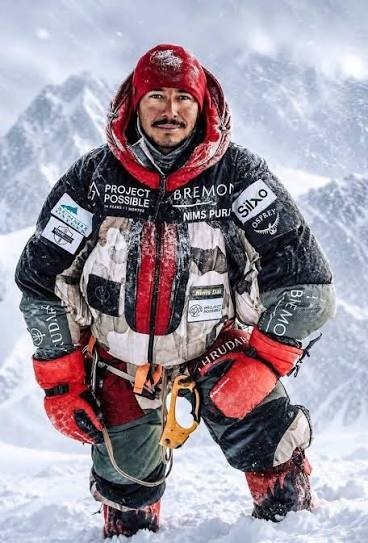
The tragic news reported earlier by NDTV regarding the missing climbers on Broad Peak has reached a heartbreaking conclusion. On August 1, 2026, expedition company Elite Exped officially confirmed that legendary mountaineer Nirmal ‘Nimsdai’ Purja and his team members—including trusted guides Pur Bahadur Gurung (Yukta) and Nima Sherpa—lost their lives following a massive avalanche on the mountain.
Earlier, when the group remained missing in the “death zone” above 6,600 metres, several of the world’s top high-altitude mountaineers spoke to NDTV’s Senior Managing Editor, Vishnu Som, analyzing the extreme risks, unforgiving conditions, and bold style that defined Purja’s career.
Mountaineers Pay Tribute & Analyze the Tragedy
1. High-Risk, High-Reward Philosophy
Indian mountaineer Arjun Vajpayee reflected on Purja’s push-the-limits mindset. Purja shattered records by scaling all 14 of the world’s 8,000-metre peaks in 6 months and 6 days in 2019. He later set out to repeat all 14 peaks without supplementary oxygen.
“Hats off to Nims for what he’s been able to achieve… Calling his approach rather risky, it is what it takes to push things to the next level and to achieve them. Above 8,000 metres in spring and autumn itself, it gets very difficult. In winters, it gets even crazier.”
— Arjun Vajpayee, Indian Mountaineer
2. The Lethal Reality of the Death Zone
Norwegian mountaineer Kristen Harila emphasized the physical strain of climbing without supplementary oxygen, noting that prolonged exposure at extreme altitudes is inherently fatal.
-
Oxygen Deprivation: Climbing without bottled oxygen requires longer acclimatization, makes the body significantly colder, and slows movement.
-
Time Limits: “If you stay above 8,000 metres for a long time, you will die,” Harila noted, highlighting that no amount of fitness can overcome physiological exhaustion indefinitely.
3. Military Discipline Meets Extreme Altitude
Former Royal Marine and Everest climber Lieutenant-Colonel Romil Bartwal credited Purja’s background in the elite Brigade of Gurkhas and Britain’s Special Boat Service (SBS) for his unique high-altitude resilience.
“What he achieved is unbelievable… That comes from repeated climbs and the mindset developed through Special Forces. It’s that mindset that made him who he was on the mountains.”
— Lt. Col. Romil Bartwal
Key Challenges Highlighted by Experts
-
Unpredictable Avalanches: Expert climbers noted that while slope geometry can theoretically suggest avalanche risks, real-time avalanches strike at extreme speeds with zero warning, often engulfing climbers before they can react.
-
Climate Change Impacts: Rising global temperatures are causing hanging glaciers to destabilize and crevasses to widen across the Karakoram range, making routes like Broad Peak far more volatile than in past decades.
-
“Summit Fever”: Experts cautioned against the psychological pressure to push forward when close to a peak, emphasizing that a disciplined decision to turn back is often the only defense against catastrophe.
Summary of the Broad Peak Tragedy
-
Incident: An avalanche struck between Camp 2 and higher elevations on Broad Peak (8,047m) on Thursday, July 30, 2026.
-
Confirmation: On August 1, 2026, Elite Exped confirmed the deaths of Nirmal Purja, Pur Bahadur Gurung, Nima Sherpa, and other international team members.
-
Legacy: Purja leaves behind an unmatchable legacy in high-altitude mountaineering, chronicled globally in the documentary 14 Peaks: Nothing Is Impossible.
