

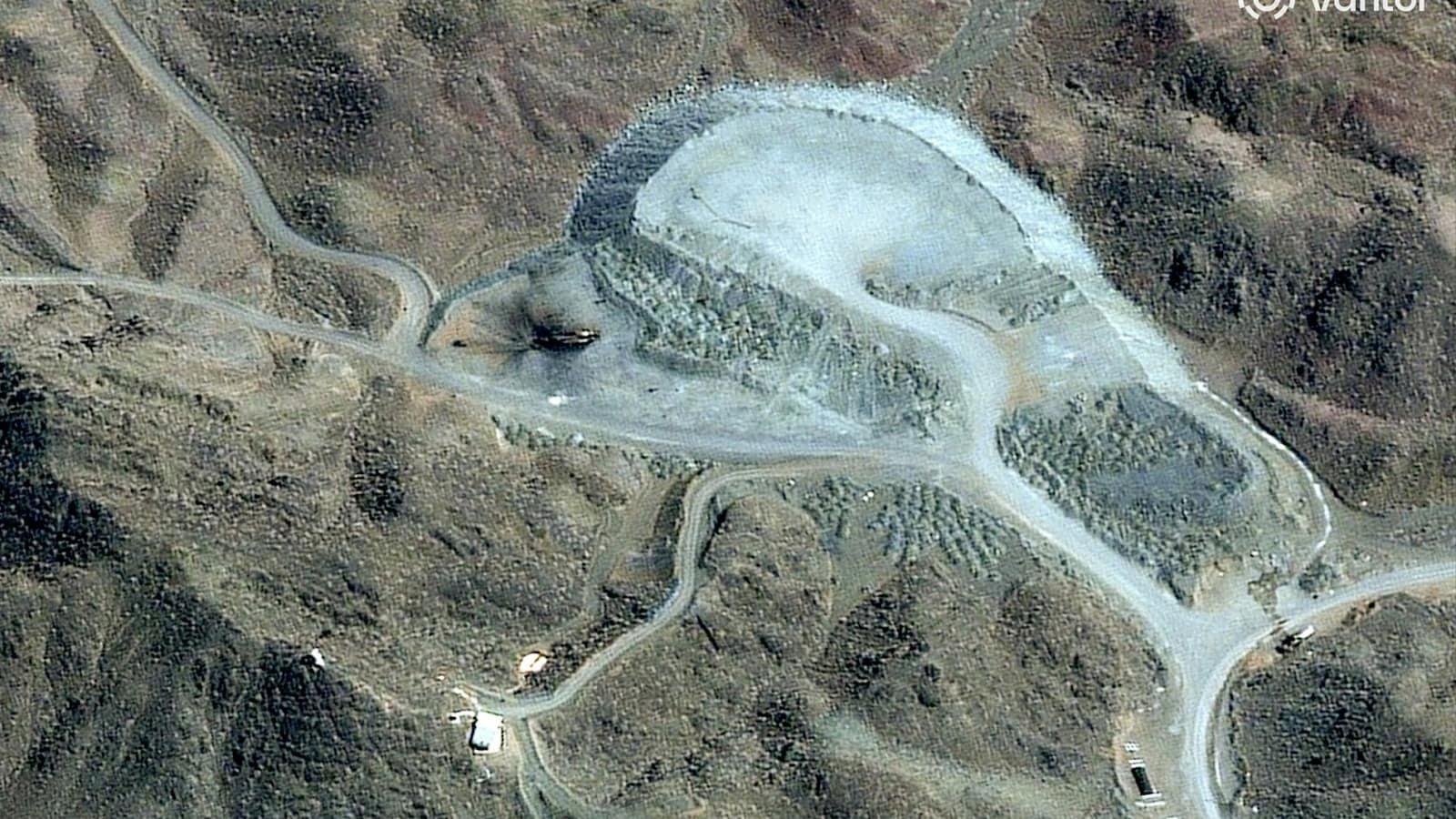
US President Donald Trump has issued a direct warning to Tehran, threatening a military strike on a heavily fortified, under-construction nuclear facility located deep beneath Pickaxe Mountain. The escalation follows ongoing conflict between the US and Iran in the Strait of Hormuz.
Speaking from the Oval Office, Trump acknowledged the possibility that Iran has already relocated advanced centrifuges to the facility—at depths that challenge the reach of conventional bunker-busting weapons.
“We’ll be hitting that area … probably pretty soon. And there’s not a thing they can do about it,” Trump stated.
Despite the rhetoric, international observers note that the exact contents inside Pickaxe Mountain remain unverified, as the International Atomic Energy Agency (IAEA) has never been granted physical access to the underground complex.
What Is Pickaxe Mountain?
Known natively as Kuh-e Kolang Gaz La, Pickaxe Mountain is situated roughly 220 kilometers (140 miles) south of Tehran and just 2 kilometers (1.2 miles) from the primary Natanz nuclear enrichment complex.
-
Fortified Position: Sprawling across 2.7 square kilometers (1 square mile), the peak rises 1,600 meters above sea level and is heavily defended by anti-aircraft batteries, perimeter fencing, and the Islamic Revolutionary Guard Corps (IRGC).
-
Deep Excavation: Satellite imagery analyzed by the Institute for Science and International Security (ISIS) suggests the complex features multiple tunnel entrances leading to a subterranean facility buried at least 100 meters (328 feet) underground.
-
Origins & Purpose: Construction began in 2020 following a sabotage explosion at the above-ground Natanz facility. Iranian officials publicly confirmed plans to build a protected underground hall for assembling advanced centrifuges. Experts believe the facility’s massive scale could allow both centrifuge production and uranium enrichment.
Technical Feasibility: Can US Munitions Destroy It?
The extreme depth of the facility presents a major engineering and military challenge for potential strikes.
| Asset / Strategy | Penetration Capabilities | Tactical Assessment |
| GBU-57 MOP (Massive Ordnance Penetrator) | Penetrates up to 60 meters (200 feet) of earth/rock | A single weapon falls significantly short of reaching a facility buried 100+ meters deep. |
| Sequential Impact (“One-Two Punch”) | Deepens the impact crater through layered detonations | US military planners have evaluated dropping multiple precision MOPs into the exact same coordinates, though effectiveness against deep solid rock remains uncertain. |
| Infrastructure Interdiction | Targets surface entry points and support systems | Striking tunnel entrances, power systems, and ventilation shafts could collapse or seal the underground facility without directly penetrating the deep bunkers. |
